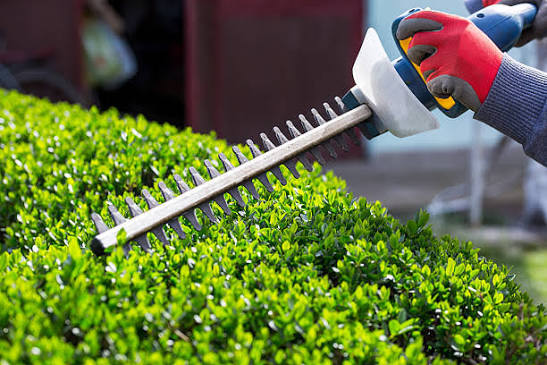
Shrub trimming is the landscape service with the most photogenic results and the least understood scope. Homeowners picture a hedge getting flattened; what a real quarterly visit delivers is a property-wide transformation — a couple dozen individual plants, each assessed and cut for its species and situation, adding up to a before-and-after that changes how the entire home reads from the street.
So let's walk one — a typical North Texas property, one quarterly shrub trimming visit, before and after, zone by zone. If you've wondered what you'd actually be buying (or what your landscape has quietly been missing), this is the tour.
Before: The privacy hedge along the front walk — ligustrum, in this case, three months past its last cut — has gone soft: the once-defined top now an uneven fuzz of new shoots, the faces bulging irregularly, a few ambitious whips standing a foot above everything. It doesn't look bad, exactly. It looks like nobody's decided anything about it lately.
After: The visit re-establishes the geometry — top sheared true and level (sighted against the house lines, because a wavy hedge top announces itself down the whole frontage), faces cut back to the profile, and the crucial detail most trimming skips: the batter preserved — faces sloping subtly inward as they rise, keeping the base slightly wider than the top so sunlight reaches the bottom growth. That geometry is why this hedge is still dense to the ground after years of cutting, while its cousins around the neighborhood stand on bare legs. Clippings blown off the top and out of the base, and the hedge reads architectural again.
Before: The matched shrubs flanking the front door — the formal punctuation of the whole entry — have drifted out of match: one fuller than the other, both encroaching on the door approach, shapes gone vague.
After: Restored to twins — shapes matched to each other and scaled to the entry, growth cleared back from the walk so guests aren't brushed on arrival, the doorway framed instead of crowded. Small work, disproportionate effect: the entry is where every visitor's eye lands first, and matched, shaped anchors there set the tone for everything else.
Before: The hollies and boxwood along the front of the house have spent three months growing toward everything they shouldn't: top growth climbing past the window sills, back growth pressing against the brick and siding, the row's front edge creeping over the bed line.
After: The clearance pass — the least glamorous, most protective work of the visit. Heights walked back below the sills (windows visible again, light back in the rooms, the sight lines a security-conscious eye appreciates). The house side cut back off the wall — restoring the gap that lets air move and siding dry, the space nobody sees and the structure depends on. The boxwood handled with its species rules (light shaping only — never cut past its green shell into the bare interior it can't regrow), the hollies shaped with more liberty. And the AC unit's corner cleared back to breathing room. From the curb: the house visibly sits forward again — foundation plantings framing it instead of swallowing it, which is the single biggest architectural effect one trimming visit produces.
Before: The individual players scattered through the beds, each mid-drift in its own way: the abelia's graceful arches gone shaggy, the nandina pushing tall leggy canes, the dwarf yaupons losing their globes, the Indian hawthorns fine but carrying dead sprigs from a leaf-spot episode.
After: The species-by-species pass that separates real trimming from buzz-everything work: the abelia pruned by removing whole canes at the base (preserving the arching character that shearing would destroy), the nandina's tallest canes cut low at staggered heights (keeping it layered, never flat-topped into pom-poms), the yaupons sheared back to crisp globes (the one plant on the property that genuinely loves the meatball treatment), the hawthorns cleaned of dead wood with airflow-minded thinning. A dozen plants, a dozen small decisions — invisible individually, unmistakable in sum.
Before and after — deliberately similar: Mid-season, the crape gets exactly what the season calls for: suckers removed from the base, nothing else. The structural work belongs to late winter (selective thinning, never topping) — and part of what a quarterly program delivers is knowing which visit does what. The crape's real before-and-after happens on the winter visit; today it just gets kept clean. Restraint, on schedule, is also expertise.
Before the final pass: A property's worth of clippings — on the hedge top, in the beds, across the walk.
After: All of it gone — beds cleared (trimming debris left in beds smothers plants and hosts pests), hard surfaces blown, the whole property carrying that just-detailed crispness. The haul-off leaves with the trailer. This last half hour is where "we trimmed the bushes" becomes "the landscape was serviced" — and it's the finish that makes the before-and-after photograph the way it does.
Step to the curb for the final comparison. Nothing dramatic happened to any single plant — no renovations, no removals — and yet the property has visibly changed category: lines crisp, windows open, entry framed, house forward, beds composed. That's the quarterly visit's real product: not a haircut, but a reset of every line the eye reads — repeated four times a year so the landscape never drifts far enough to need more than resetting. The properties that always look like this aren't trimming harder. They're trimming on rhythm.

Get the before-and-after on your calendar. Kangaroo Outdoor Solutions provides quarterly shrub trimming — species-smart cuts, house clearances, and complete cleanup, four times a year. Build your quote today and see what one visit changes.