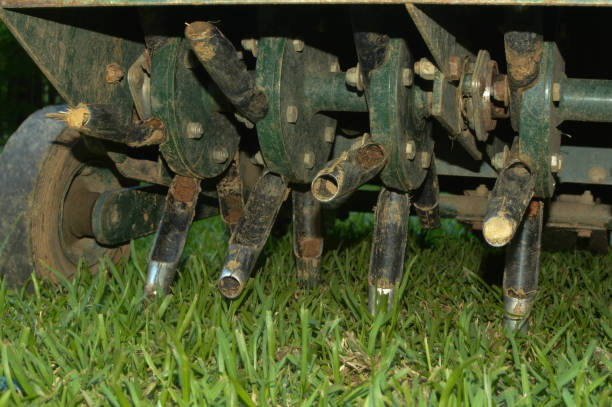
Core aeration generates more homeowner questions than almost any lawn service — probably because it's the one that leaves visible evidence (those plugs everywhere), involves a machine most people have never operated, and gets recommended constantly without much explanation. Fair enough. Here are the ten questions we hear most about core aeration, answered straight.
For the clay-heavy soils across North Texas: once a year minimum, twice a year (spring and fall) for best results. Clay compacts continuously — from traffic, mowing, rain, and its own density — so aeration is maintenance, not a one-time repair. High-traffic lawns (kids, dogs, entertaining) and lawns being pushed toward showcase condition benefit most from the twice-yearly rhythm. A sandy-loam lawn elsewhere might stretch intervals; Parker County clay does not.
Both sit inside the golden rule: aerate while the grass is actively growing so it recovers fast and fills the holes with roots. Spring aeration builds root depth ahead of summer heat; fall aeration relieves a whole summer's compaction and pairs with the year's most important feeding. If choosing one, match it to your lawn's bigger problem — summers that scorch it (spring) or a generally tired, compacted state (fall). Avoid aerating dormant lawns and drought-stressed lawns in extreme heat.
Not when it's done right — and this is the question that separates professional service from the rental-machine weekend. Tines punch several inches deep, exactly where heads and shallow lines live, which is why every head and shallow component gets flagged before the machine runs. Professionals mark and steer; DIY renters who skip the flagging step fund the local irrigation repair economy.
No — and please don't. The cores are your own topsoil and nutrients; they break down over one to two weeks (faster with watering and mowing, which crumbles them harmlessly) and return to the lawn. Raking them up throws away soil and labor at the same time. They look untidy briefly. That's the whole price.
Not remotely. Core aeration removes soil — hollow tines extract plugs, leaving space the surrounding soil can relax into. Spike devices just poke holes, removing nothing and compressing the hole walls tighter — arguably worsening compaction. The field test: if there are no plugs on the lawn afterward, it wasn't core aeration. Insist on cores.
Ten-second tests: water pooling or running off during irrigation (soil won't absorb), the screwdriver test failing (won't push into soil without force), thin turf despite decent care, worn traffic paths, and — the near-universal qualifier — clay soil that's never been aerated. If several apply, the lawn's been waiting.
Two things help: water the lawn a day or so beforehand if rain hasn't — lightly moist soil yields deep, clean plugs, while baked-dry clay fights the tines — and mark anything unusual buried shallow (dog fence wire, low-voltage lighting runs, that DIY drain line) that a crew couldn't know about. Mowing shortly before is a nice-to-have, not a must.
Three moves multiply the value: water well over the following days (the opened lawn absorbs like never before, and moisture drives the recovery), fertilize into the holes — the classic pairing, dropping nutrients straight to the root zone through thousands of open channels — and mow normally, which finishes off the plugs. Then just watch: infiltration improves almost immediately; density and color build over the following weeks.
Yes, with coordination — the standard professional practice sequences them so the aeration and the weed barrier each do their jobs. It's a scheduling detail, not a conflict, and it's exactly the kind of timing question that gets handled automatically when the aeration and the turf program run on the same company's calendar.
Here's the honest frame: aeration is the service that makes your other investments work. Water, fertilizer, and rainfall are all being delivered to the top of your soil — and compacted clay decides how much of each actually reaches roots. On tight soil, a meaningful share of everything you pay for runs off or sits on the surface. One aeration pass changes the delivery math for the entire season. It's not the glamorous line item. It's the leverage one.

Questions answered — ready for the plugs? Kangaroo Outdoor Solutions provides professional spring and fall core aeration: irrigation flagged, deep hollow-tine cores, and perfect pairing with fertilization. Build your quote today and open your soil up.