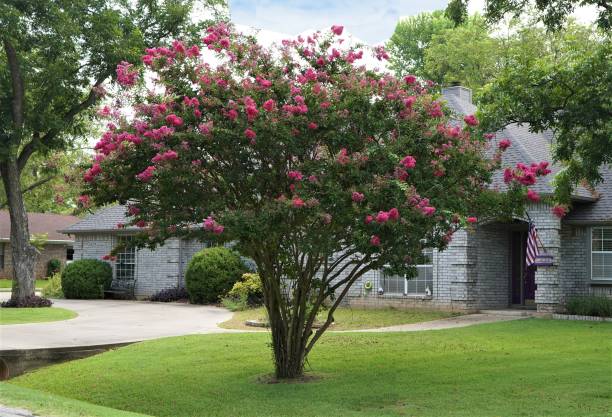
No plant defines the Texas summer landscape like the crape myrtle. When July heat has everything else conserving energy, crapes erupt — masses of white, pink, watermelon-red, and purple bloom held over sculptural trunks with that unmistakable smooth, mottled, peeling bark. They're in nearly every neighborhood, every commercial frontage, every established landscape — beloved, tough, and spectacular.
They are also the most abused plant in America. Every winter, in a ritual so widespread it earned its own name, healthy crape myrtles across the region get hacked down to thick knuckled stubs — "crape murder" — by homeowners and crews who genuinely believe they're helping. They aren't. And because crapes are so common and so mistreated, a real care guide is worth its length. Here's everything: how these plants actually work, the pruning that helps versus the pruning that harms, the problems to watch for, and the year-round calendar that keeps a crape magnificent for decades.
Crape myrtles are large shrubs to small trees — depending entirely on variety, and variety is destiny: mature sizes range from dwarf forms staying a few feet tall to standard varieties reaching twenty-five feet and beyond. A huge share of crape problems trace to this single fact — a twenty-foot variety planted in a ten-foot space, then fought with a saw forever. (If you're planting new, matching the variety's mature size to the spot prevents the entire next section from ever being necessary.)
Three traits drive all crape care decisions:
They bloom on new wood. Each summer's flowers form on the current season's growth — which is the fact crape murder misuses: yes, hard cutting forces new growth and blooms. But crapes bloom generously on new growth from a natural structure too; the butchery was never required for flowers.
Their form is the point. A mature crape's value is as much architectural as floral — the multi-trunk vase shape, the muscular smooth limbs, the winter bark display. This is a plant whose structure is a four-season feature, which is exactly what topping destroys.
They're tough. Heat-loving, drought-tolerant once established, and vigorous — which is why they survive the annual mutilation at all. Their resilience has been mistaken for endorsement.
The crime scene is familiar: every trunk and limb cut flat at the same height — often chest-to-head high — leaving a fist of thick stubs. The usual justifications: "it makes them bloom more," "they're getting too tall," "everyone does it." Here's what the practice actually produces:
If you've inherited murdered crapes, there's hope in the restoration section below. First, the right way.
Correct pruning works with the plant's natural vase form and follows one principle: remove whole branches at their origin — never shear or top. The professional checklist, worked in late winter while the plant is dormant and its structure fully visible:
Notice what the list never includes: cutting every limb at one height. A properly pruned crape looks like itself, edited — cleaner, more open, structurally elegant — not like furniture.
Timing: late winter is the classic window (dormant, pre-growth-push, full structural visibility). What to avoid: heavy pruning in fall, which stimulates tender growth into freeze season, and shearing anytime.
Inherited the knuckles? Restoration is real, and it runs one of two roads:
The patient road: After the spring whip eruption from each knuckle, select the two or three strongest, best-placed shoots per stub and remove all the rest. Those keepers get a season to thicken; next winter, repeat the selection discipline. Over two to three years, the chosen shoots mature into legitimate branches and the canopy rebuilds a semi-natural structure above the old wounds. The knuckles remain visible scars, but the plant recovers its form and its dignity.
The reset road: For the worst cases, crapes tolerate full renewal — cutting the entire plant near the ground in late winter and regrowing from scratch, selecting new trunks from the resulting shoots exactly as with a young plant. It costs a few years of size and delivers a genuinely clean start. Vigorous species, remember — this is one of the few plants where the nuclear option is a legitimate technique.
Beyond pruning abuse, crapes carry a short, recognizable trouble roster:
Aphids and sooty mold — the black-leaf mystery solved. The most common crape complaint: leaves, branches, and everything beneath the tree (patio furniture, cars) turning sticky, then coated in black film. The chain: crape myrtle aphids feed on the foliage and excrete sugary honeydew; sooty mold — a black fungus — grows on the honeydew. The mold itself is cosmetic; the message is aphids above. Management runs from horticultural controls to systemic treatments in serious cases — and note that stressed, whip-growth (murdered) crapes host aphids worst, one more bill from the topping habit.
Powdery mildew. White dusty coating on leaves and buds, worst in humid stretches and on older susceptible varieties, distorting new growth and blooms. Airflow from proper open pruning helps; resistant varieties largely solved this in modern plantings; treatments exist for valued susceptible plants.
Crape myrtle bark scale. The newer arrival worth knowing: white-gray felty bumps on trunks and limbs, producing honeydew (and thus sooty mold) like aphids do — often the culprit when black mold appears with few aphids in sight. Distinctive, spreading regionally, and worth professional identification and treatment when it shows.
Sparse bloom. Usually one of three: too much shade (crapes want full sun and sulk without it), excessive nitrogen (lush lawn-fertilizer overspray grows leaves at bloom's expense), or over-pruning stress. Rarely a mystery once those three are checked.
The through-line of everything above: the crape myrtle is a plant that rewards restraint and selection and punishes volume cutting — the exact opposite of how it's commonly treated. It's also, honestly, a plant whose correct care takes judgment: which trunks to keep, which shoots to select, what that black film means, when the saw helps and when it harms. That judgment is precisely what a professional trimming program brings to the landscape's most visible tree — the late-winter structural visit, the growing-season problem-spotting, and the guarantee that nobody ever tops it.

Give your crapes the care they've earned — and never the saw treatment they haven't. Kangaroo Outdoor Solutions' quarterly shrub trimming includes proper late-winter crape myrtle pruning, restoration of topped trees, and season-long trained eyes on your landscape. Build your quote today and keep Texas's favorite tree magnificent.