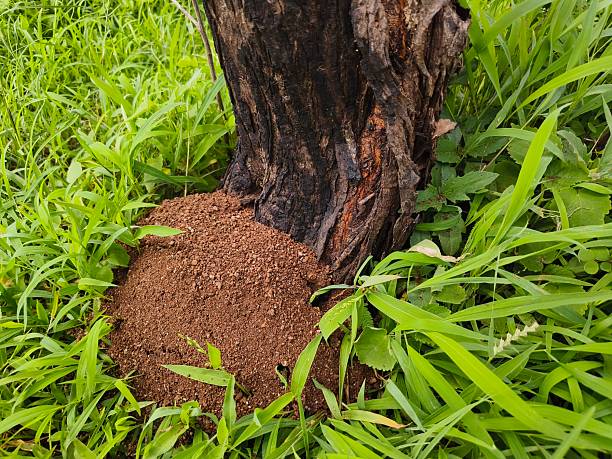
Every Texas homeowner knows the moment: you're walking the lawn, you glance down, and your shoe is planted six inches from a fresh mound of crumbly soil that wasn't there last week — already boiling with reddish-brown ants that took your footstep personally. Fire ants aren't just a lawn problem. They're a family problem — a genuine hazard to kids, pets, and anyone who kneels in the wrong spot — and they're one of the most persistent, frustrating invaders a Texas yard ever hosts.
They're also widely mismanaged, which is why the same yards fight the same mounds every single year. Here's the honest guide: how to know it's fire ants, why the boiling-water-and-grits folklore fails, and the two-step strategy that actually reduces the population instead of just relocating it.
Not every ant hill is a fire ant mound, and the response differs — so confirm first:
One important reframe: the mound you can see is the smallest part of the colony — a nursery and solar heater above a nest that extends deep and wide underground, with a queen (sometimes multiple queens) producing thousands of eggs. This single fact explains almost every fire ant treatment failure that follows.
The internet's fire ant playbook — boiling water, grits, club soda, shoveling mounds apart — shares one fatal flaw: none of it reliably reaches the queen. Kill ten thousand workers and miss her, and the colony rebuilds; disturb the mound violently and the colony's classic response is to move — which is why aggressive DIY attacks so often produce the maddening result of the mound "coming back" ten feet away in three days. It didn't come back. It relocated, intact, with its queen — and now you have a rattled, defensive colony and a torn-up lawn.
The mound-drenching approach (properly done with labeled products, not stovetop water) can kill a colony when the drench actually penetrates to the queen — but it's a per-mound tactic in a war that isn't per-mound, which brings us to the strategy that actually works.
Texas A&M's AgriLife Extension — the closest thing fire ant management has to a governing authority — has spent decades refining the approach, and it's built on exploiting the colony's own behavior:
Fire ant baits are granules of food laced with slow-acting active ingredients. Foraging workers — who range far beyond visible mounds — collect the bait, carry it home, and feed it through the colony's food-sharing chain until it reaches the queen herself. That Trojan-horse delivery is the whole genius: instead of you finding the queen, the ants deliver the payload to her.
Broadcast the bait across the entire lawn — not just on mounds — because the yard hosts far more colonies than visible mounds suggest, including young colonies that haven't built domes yet. Bait discipline matters: apply when ants are actively foraging (warm but not scorching — spring and fall are prime), use fresh bait (the attractant oils go rancid; old opened bags get ignored), and apply to dry grass with no rain or irrigation imminent, since soggy bait is spurned bait.
The trade-off: baits are slow — weeks to collapse colonies — which is exactly why there's a step two.
For the mounds that can't wait — the one by the swing set, the porch step, the mailbox path — individual mound treatments (drenches or granular applications per label) kill fast where speed matters. Used alongside broadcast baiting rather than instead of it, mound treatments handle the immediate hazards while the bait quietly dismantles the population underneath.
Two-step, repeated on a rhythm (typically spring and fall broadcast rounds), is how properties go from mound-whack-a-mole to genuinely low fire ant pressure — and stay there.
Fire ant management interacts with the rest of your lawn program more than most homeowners realize:
Fire ants earned their place as Texas's most personal lawn problem — they're the invader that actually hurts people. But they're also one of the most manageable problems in the yard once the strategy matches the biology: bait the whole population on schedule, hit the hazard mounds fast, keep eyes on the lawn weekly, and let the queen-delivery system do the work no shovel or stovetop ever could. The mounds stop being a summer-long emergency and become a maintenance line item — handled, like everything else on a well-run property.

Tired of the mound-by-mound battle? Kangaroo Outdoor Solutions keeps trained eyes on your lawn every week and your whole property on a program — so problems like fire ants get spotted early and handled right. Build your quote today and take the yard back for the people who live there.