Fresh Cut Lines, Clean Edges, Clear Driveways: What a Just-Serviced Lawn Should Look Like

March 31, 2025

The crew just left. The mowers are loaded, the trailer's pulling away, and you're standing on the porch looking at your lawn asking the question every maintenance customer eventually asks: is this good? The grass is shorter — but is the work actually right?

Most homeowners never learn how to evaluate a lawn maintenance visit, so they judge on vibes: looks fine, seems shorter, okay. But a professionally serviced lawn has specific, visible, checkable features — and once you know them, a thirty-second walk tells you exactly what quality of service you're receiving. Here's the complete visual inspection guide: what a just-serviced lawn should look like, feature by feature, and the tells that separate a real maintenance visit from a fast mow-and-go.

Check #1: The Cut Itself — Even, Clean, and the Right Height

Start with the grass, and look for three things:

  • Uniform height everywhere. A quality cut reads as one continuous surface — no missed strips (the pale stripes where passes didn't overlap), no ridges between rows, no rough patches where the deck bounced. Walk the lawn diagonally against the mowing direction and unevenness reveals itself immediately
  • Clean blade tips, not torn ones. Look close at the grass ends: sharp mower blades leave crisp cuts; dull blades tear, leaving frayed, whitish, shredded tips that will brown the whole lawn's surface within a day or two. If your lawn consistently looks stressed and gray-brown 24 hours after service, inspect the tips — the answer is usually on the blade, not in the soil
  • Height that matches the season. A summer cut should be noticeably taller than a spring one — the raised-deck heat protocol in action. A lawn buzzed short in July isn't efficient service; it's damage on a schedule. You should be able to see the seasonal logic in the height

And one pattern note: over the weeks, the direction of the cut should visibly change — this week's lines running differently than last week's. Same-direction-every-visit mowing carves wheel ruts and trains the grass to lean; rotating patterns is a professional habit you can verify from the porch.

Check #2: The Edges — The Sharpest Tell in Lawn Care

Walk the driveway and sidewalk lines. This is where service quality is most visible and most often skipped:

  • A true vertical edge — a clean, crisp line where turf meets concrete, with a small defined gap showing the soil face — is the signature of real edging with a blade edger. It reads sharp from the street and lasts between visits
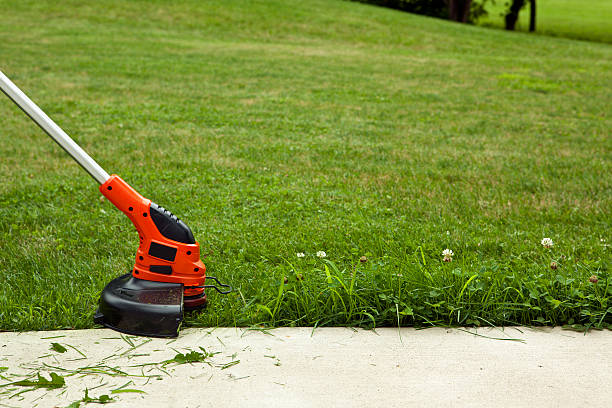
  • The impostor: a ragged, scalped, browning strip along the pavement is a string trimmer tilted sideways doing edging cosplay — faster for the crew, worse for the lawn, and visibly rougher within days
  • The skip: grass creeping over the pavement in soft tongues, no line at all — the tell of a service that mows and leaves. If the driveway margins look fuzzy an hour after the crew left, edging wasn't part of the visit, whatever the invoice says

Bed edges count too: the line where lawn meets mulch should be defined — turf on one side, bed on the other, no blur.

Check #3: The Trim Work — Seamless, Not Scalped

String trimming handles everything the mower can't reach: fence lines, mailbox posts, tree rings, bed borders, corners, around the AC and utilities. The quality standard is invisibility — trimmed areas should match the mowed height so exactly that you can't tell where the mower stopped and the trimmer started. The failure modes are both visible:

  • Scalped rings — brown, buzzed-to-dirt circles around every tree and post, from trimming too low. Repeated weekly, these become permanent bare rings and weed nurseries
  • Missed zones — tall tufts standing along the fence, behind the shed, around obstacles: the spots that tell you the visit was mow-only

Check #4: The Cleanup — The Finish That Defines "Done"

The last five minutes of a visit determine whether the property looks serviced or just shorter:

  • Every hard surface blown clean. Driveway, sidewalks, curb line, patio, porch — zero clippings. A lawn service that leaves grass all over the concrete has left the job visibly unfinished, and it's the first thing every visitor's eye catches
  • No clippings in the beds. Clumps of grass blown or thrown into the mulch smother plants and look sloppy — beds should be as clean after the visit as before
  • No clumps on the lawn. Properly frequent mowing produces fine clippings that vanish into the turf; visible ropes and mats of clippings mean either wet cutting or too much growth removed — either way, they shouldn't be left to smother patches
  • Gates closed — the small professionalism habit that pet owners rank first, and a fair proxy for the crew's overall care level

The 60-Second Post-Visit Walk

Compress it into a routine: walk the driveway line (edges true?), scan the lawn diagonally (even cut? clean tips? clumps?), check one fence line and one tree ring (trim quality?), glance at the beds (clean?), and look at the concrete (blown?). Sixty seconds, five checks — and you know exactly what you're paying for.

Here's the honest close: every item on this list is standard on a professional maintenance visit — the full mow-edge-trim-blow service, every week, at seasonal heights with sharp blades and rotating patterns. If your current service passes the walk, keep them. If it doesn't, the gap between what you're getting and what the lawn deserves is now visible — and fixable.

Get the visit that passes every check. Kangaroo Outdoor Solutions delivers complete weekly lawn maintenance — true edges, seamless trim, clean surfaces, and a finish you can inspect with confidence. Build your quote today and see the difference on your first walk.