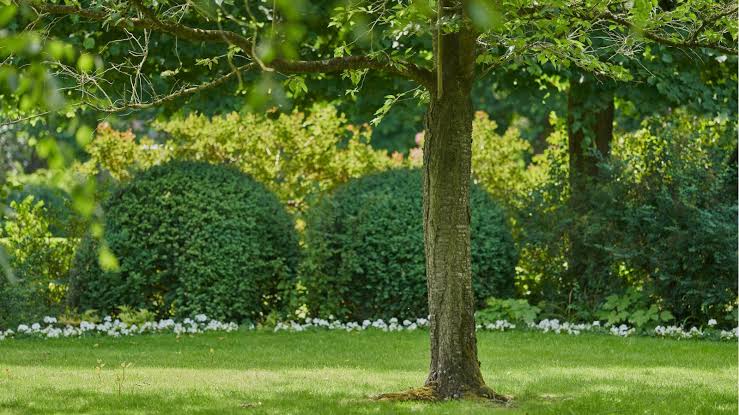
Every neighborhood has these yards: a beautiful, thriving lawn that goes green and thick everywhere the sun touches — and then, under the big oak, a stubborn circle of bare dirt, moss, and struggling grass sprigs that no amount of seed, water, or hope has ever fixed. The homeowner has usually tried everything twice. The dirt circle remains.
Here's the honest truth that will save you years of that fight: the dirt circle isn't a care failure — it's a light problem, and light problems can't be watered or fertilized away. But that doesn't mean surrender. It means understanding what shade actually does to turf, knowing which grasses can genuinely handle how much of it, and — where grass truly can't win — knowing the alternatives that look better than struggling turf ever did. Here's the complete guide.
Grass is a full-sun plant at heart — a photosynthesis machine that converts light into the energy for blades, roots, and recovery. Shade attacks it from four directions at once:
Under heavy canopy, turf may receive a small fraction of the light it evolved for. The plant responds predictably: thin, stretched, weak blades reaching for light; shallow roots (no energy budget to grow them); and near-zero recovery capacity — every stress, from foot traffic to fungus, hits a plant with no reserves.
The tree casting the shade is also competing underground — a mature tree's root system dominates the soil beneath its canopy, drinking the water and nutrients first. The grass under a tree isn't just light-starved; it's losing a resource war to an opponent a thousand times its size.
Shaded turf stays damp longer (less evaporation, less airflow) — which sounds nice until you remember what loves prolonged leaf wetness: fungal disease. Shade zones are brown-patch country, and the moss that colonizes them is the flag of chronically damp, thin, compacted ground.
And here's how homeowners make it worse: seeing struggling grass, they water it more (feeding the fungus and the moss) and fertilize it more (forcing growth the light budget can't support — like revving an engine with no fuel line). Shade turf needs less of both, not more.
"Shade-tolerant grass" is real — but tolerance has hard limits, and knowing your grasses' rankings sets honest expectations:
So step one of any shade strategy is grass ID plus a light audit: how many hours of direct or bright dappled sun does the zone actually get? Several hours of quality light → shade-appropriate turf has a real chance with the right care. Less than that → it's time for the honest alternatives.
For the borderline zones — real but limited light — shade turf runs on different rules than sun turf:
Here's the mindset shift that ends the multi-year dirt-circle war: in deep shade, the alternatives don't just beat struggling grass — they beat it aesthetically. The professional playbook:
A generous, properly edged mulch bed around the tree — wide enough to cover the whole failure zone — transforms the eyesore into a design feature overnight. It looks intentional and high-end, it's genuinely better for the tree (moisture retention, no mower and trimmer wounds on the trunk, no turf competing at the root flare), and it costs a fraction of another season of failed grass attempts. Rules apply: proper 2–3 inch depth, and mulch pulled back from the trunk itself — a flat donut, never a volcano piled against bark
Where you want more than mulch: the shade-garden roster — from groundcovers to shade-tolerant shrubs and perennials — thrives in exactly the conditions that kill grass, converting the dead zone into the most interesting bed on the property. (Planted thoughtfully around root zones and maintained like any bed — with the same weed-control and trimming rhythm)
If the shade zone is also a traffic route, stepping stones or a path through the mulch acknowledges reality gracefully — infrastructure where turf was always going to lose
The homeowners who finally beat the dirt circle all do the same thing: they stop asking "what product fixes this?" and start asking "what does this light actually support?" Sometimes the answer is shade-appropriate turf with shade-appropriate care and a raised canopy. Often, it's a beautiful mulch ring or shade bed that looks better than the grass ever could have. Either way, the years-long fight ends — replaced by a landscape where every zone is planted for the conditions it actually has. That's not surrender. That's design.

Tired of fighting the shade? Kangaroo Outdoor Solutions can assess your light, care for what turf can thrive, and convert what can't into clean mulched beds and landscape features — all on one maintenance program. Build your quote today and put every zone of your yard on a winning plan.