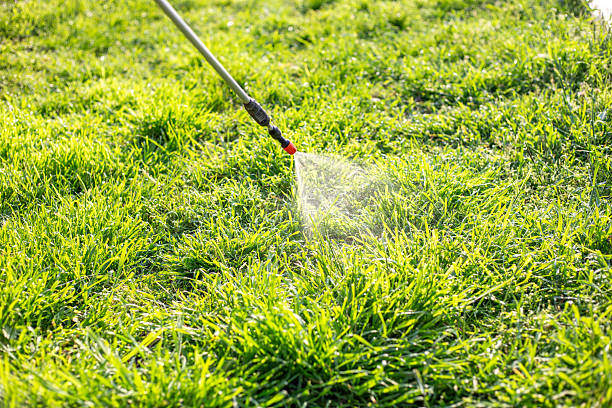
Every weedy lawn has a garage shelf telling its story: the weed killers that worked for two weeks, the weed-and-feed bags that did neither, the sprayers, the receipts. Homeowners fight lawn weeds constantly — and the weeds keep winning, season after season, because the fight is being waged against individual plants while the actual enemy is a system.
A turf control program wins because it attacks the system. Not one product, not one weekend — a coordinated year of prevention, targeted elimination, and turf building that dismantles the weed cycle at every stage. Here's exactly how a turf control program gets rid of weeds for good, step by step, and why it succeeds where the garage shelf failed.
Weeds return for three reasons, and any plan that misses one is doomed to repeat:
The first is the seed bank. Your soil holds years of accumulated weed seeds — thousands upon thousands, deposited by every weed that ever flowered on or near your lawn, carried in by wind, birds, and pets. Killing the weeds you see does nothing to the reserve waiting underground. Two weeks later, the next generation germinates, and the cycle looks like your weed killer failed. It didn't. It was never aimed at the real population.
The second is timing. Most weeds in a North Texas lawn are annuals that germinate in predictable windows — crabgrass and the summer class as soil warms in late winter and spring, henbit and the winter class as soil cools in fall. Fight them after they emerge and you've already conceded the easy battle; the window to stop them cheaply closed weeks before you noticed them.
The third is thin turf. Weeds don't invade healthy, dense lawns easily — they exploit openings: bare spots, scalped edges, thinning zones, stressed grass. A lawn that's weedy is almost always a lawn that's thin somewhere, and killing the weeds without thickening the turf just clears the ground for the next arrivals.
A turf control program is built as a direct answer to all three.
The program's foundation is pre-emergent herbicide — the treatment that stops weed seeds from ever becoming weeds. Applied before germination windows open, pre-emergent forms a barrier in the top layer of soil that shuts down seedlings as they sprout. The weeds simply never appear.
Timing is everything, which is why the program runs multiple rounds: the late-winter application before the summer weed class wakes, a second spring round extending coverage through the long germination season, and the fall application blocking the winter weeds that would otherwise green up across your dormant lawn in February. Each application is timed to soil temperature — not the calendar — because the windows shift every year, and a barrier applied two weeks late is a barrier the earliest weeds already walked through. Tracking those windows is precisely what the program does that the weekend schedule can't.
The compounding effect is the beautiful part. Every weed prevented is a plant that never drops its thousands of seeds — so each program year drains the seed bank instead of restocking it. Year one suppresses the invasion. Year two faces a smaller army. By year three, the lawn's weed pressure is structurally lower, permanently.
Prevention handles the future; the existing weeds need targeted removal. The program's post-emergent work is precision, not blanket spraying — the applicator walks the lawn treating actual weeds with products matched to each type and safe for your specific grass. That matching matters enormously: the product that handles broadleaf weeds does nothing for nutsedge, the treatment safe on Bermuda can injure St. Augustine, and the stubborn perennials like dallisgrass need systemic products applied over multiple rounds to kill their root systems rather than just burning their tops.
This is exactly where the DIY approach breaks down — wrong product for the weed, wrong product for the grass, mature weeds that shrug off treatments meant for seedlings. The program brings identification and the right chemistry to each target, round after round, until the established population is genuinely gone.
The final front is the one no herbicide addresses: the openings weeds exploit. The program's fertilization schedule runs alongside the weed work all year — the spring feeding fueling density as the lawn wakes, heat-safe summer applications keeping turf strong through the stress season, and the critical fall feeding that rebuilds summer thinning and banks reserves for next spring.
Fed turf grows thick, and thick turf is the permanent weed control: a dense canopy shades the soil so weed seeds never see the light many need to germinate, and full coverage leaves no bare ground to colonize. Combined with proper weekly mowing at the right height, the lawn becomes its own defense — which is the end state the whole program builds toward: not a lawn where weeds keep getting killed, but a lawn where weeds can't get started.
Set real expectations. In the first months, existing weeds visibly die off and color improves with feeding. Through the first full year, the pre-emergent rounds take hold and the annual invasions shrink dramatically, with the stubborn perennials worn down over repeated treatments. By the second year, the seed bank depletion shows — the spring flush a fraction of what it was, the turf noticeably denser. The lawns that look effortlessly weed-free are almost always multi-year program lawns, and now you know the machinery underneath.
For good, in lawn care, means a system running on schedule — prevention landing in every window, breakthroughs treated while small, turf thickening season over season. That's not a product. That's a program.

End the weed cycle instead of repeating it. Kangaroo Outdoor Solutions' Turf Control Program delivers the full year of timed pre-emergents, targeted treatments, and turf-building fertilization. Build your quote today and start your last first year of fighting weeds.