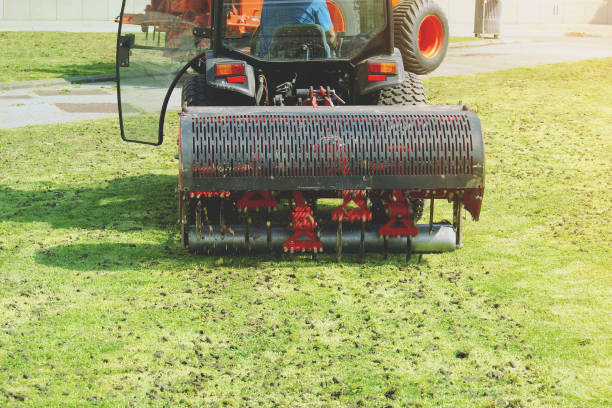
Every few summers, Texas runs the full drought experiment: weeks without rain, watering restrictions tightening, and lawns across every neighborhood sorting themselves into two groups — the ones that hold on and the ones that let go. The sorting looks random from the street. It isn't. Drought survival is built in advance, underground, and the single service that builds more of it than any other is core aeration. Here's the connection — how opened soil becomes drought armor, and why the lawns that ride out dry summers almost always have an aeration rhythm in their history.
When the rain stops and the watering gets rationed, a lawn lives on whatever moisture it can reach — and reach is the whole game. Soil dries from the top down: the surface inch goes first, baking dry within a day of summer sun, while moisture persists deeper down for days and weeks. A lawn with deep roots drinks from that persistent reserve and rides out the gaps between waterings. A lawn with shallow roots lives entirely in the layer that dries first — wilting within hours of the surface going dry, no matter how much water sits eight inches below it.
So the question that decides your lawn's drought fate is simple: how deep do its roots go? And on North Texas clay, the honest answer for most lawns is: as deep as the compaction allows — which isn't deep. Clay pressed tight by years of traffic and settling is physically impenetrable to roots beyond the top couple of inches. The lawn didn't choose shallow roots. The soil imposed them — and imposed, along with them, a structural vulnerability to every dry stretch.
Core aeration attacks that imposed shallowness directly. The extracted plugs leave thousands of open channels several inches deep — physical corridors through the compacted layer that roots could never crack on their own. In the growing weeks after aeration, the actively spreading root system follows those channels downward, colonizing depth that was simply unavailable before.
Run the rhythm — spring and fall, season after season — and the effect compounds: each pass opens more of the profile, each growing season's roots push deeper into it, and the lawn gradually converts from a surface-dwelling root system to a genuinely deep one. That conversion is drought preparation in its purest form. The spring pass matters most for the coming summer: soil opened as the lawn enters peak growth means the whole spring gets spent building the roots that July will test.
The second half of the drought connection is what aeration does for the water itself. Compacted clay sheds rain and irrigation — the moisture that should be recharging the deep profile runs off to the curb instead, so even generous spring rains leave sealed soil shallow-wet and deep-dry. When drought arrives, there's no reserve to draw on, because the ground never accepted the deposits.
Aerated soil accepts them. Water infiltrates through the channels and wets the profile deep — spring rains and normal irrigation banking as stored soil moisture that the deep roots then live on through the dry stretch. And under watering restrictions, the effect doubles: when you're limited to assigned days, a soil that absorbs everything you're allowed to apply delivers the full ration to the roots, while a sealed soil wastes a share of an allowance that can't be supplemented. Aeration is, quite literally, efficiency insurance for the exact weeks efficiency is mandatory.
Put the pieces together and the neighborhood sorting explains itself. The aerated lawn enters the drought with deep roots drinking from a charged profile, absorbs every restricted watering fully, and holds color and life through weeks that should brown it — then recovers fast when rain returns, because the root system never collapsed. The compacted lawn enters with surface roots over an empty profile, sheds half of every allowed watering, browns early, and spends the fall recovering — if it recovers.
Same weather. Same restrictions. The difference was decided in the spring, by a machine pulling plugs — which is the whole lesson of drought and lawns in one line: you can't water your way out of shallow roots in August, but you can aerate your way out of them in April. The lawns that survive Texas droughts are the ones that prepared while it was raining.

Build your lawn's drought armor before the next dry summer tests it. Kangaroo Outdoor Solutions provides spring and fall core aeration — deep hollow-tine cores that open your soil and free your roots. Build your quote today and get ready while it's still raining.