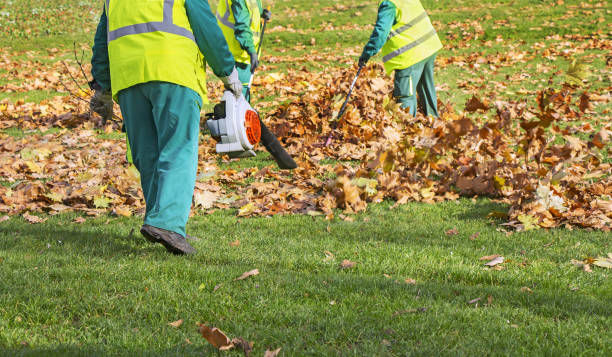
Leaf removal gets sold — and bought — as a lawn service, and fair enough: the turf under a matted leaf layer takes real damage, and protecting it is reason alone. But framing leaf removal as grass care undersells the service by half. Leaves don't only land on lawns. They land everywhere — and everywhere they accumulate, they cause a different kind of trouble, most of it quieter and some of it more expensive than anything happening to the grass.
Here's the whole-property case for leaf removal: what accumulating leaves do to your flowerbeds, your drainage, your home's perimeter, and your outdoor spaces — and why a complete removal covers all of it, not just the open turf.
Beds are leaf traps by design — bordered, planted, sheltered from wind — and they collect and hold leaves that open lawn would shed. What happens next hurts more than most homeowners realize.
Leaves matting around shrub crowns and stems trap constant moisture against exactly the plant tissue that needs to stay dry — the conditions that invite stem rot and fungal problems through the cool, damp months. The same wet layer becomes winter housing for pests, sheltered right at the base of your plantings. And the accumulation buries the mulch layer beneath it, blocking the bed's actual protective system while adding a decomposing mat that smothers groundcovers and low plantings entirely.
By spring, the un-cleared bed tells the story: plants that declined over winter at the base, pest activity where the layers sat deepest, and a mulch surface that needs restoration under the rotted leaf residue. A complete leaf removal clears the beds every visit — around every crown, along the foundation row — precisely because the beds pay the highest per-leaf price on the property.
Every property moves water somewhere — through swales, along curb lines, into drains, off roofs through gutters and downspouts — and fall drops leaves directly into all of it, right before the winter storm season arrives to test the system.
Leaf dams in drainage paths convert rain into standing water: the swale that backs up across the lawn, the curb line that ponds, the drain inlet sealed under a soggy mat. Standing water then runs its own program — drowned turf, breeding mosquitoes in the mild stretches, and erosion where blocked flow finds new routes. Worst positioned of all is water held near the foundation, where North Texas expansive clay makes chronic moisture swings a genuinely expensive neighbor.
The gutters deserve their own line: a roof's worth of leaves concentrates into the gutter run, and clogged gutters overflow at the walls — sheeting water down siding and pooling it at the slab, the exact opposite of what the system exists to do. Whether gutter clearing is inside a given leaf service's scope is worth confirming explicitly — but either way, it's on the property's fall checklist, because leaf season and gutter blockage are the same event.
The timing point matters: drainage clearing is only protective if it happens before the storms. A complete leaf removal opens the water paths as part of every visit — the small, unglamorous work that decides how the first big winter rain goes.
Wind sorts leaves into drifts, and drifts pile against structures: the fence corners, the garage side, behind the AC unit, along the foundation, under the deck edge. Those deep accumulations are the property's most persistent leaf problem — they don't blow away, they don't decompose cleanly, and they sit for months doing quiet damage: holding moisture against fence posts and siding, harboring pests at the structure line, and in the dry stretches, stacking seasoned tinder against everything you'd least want it near.
The perimeter dig-out — corners, fence lines, structure edges — is the part of leaf removal that separates a complete service from a lawn-only pass. It's also the part homeowners doing their own cleanup most reliably skip, because it's the slowest, least satisfying share of the work. It's in the professional scope for a reason.
Finally, the livability layer. Fall is prime porch-and-patio season in Texas — the weather everyone waited all summer for — and unmanaged leaves take the outdoor spaces first: slick wet layers on walks and steps, furniture buried, the patio unusable without a cleanup before every use. Cleared hard surfaces, blown spotless as every removal's finish, keep the season's best months available — a small benefit that households feel weekly.
Add it up and the real scope of leaf removal comes into focus: the lawn cleared before matting damage, yes — and the beds protected at the crowns, the drainage opened before the storms, the perimeter dug out, the gutters accounted for, the living spaces kept usable, and all of it hauled away rather than piled somewhere new. That's what complete means, and it's the standard worth confirming with any service: leaves fall on the whole property, and the removal should meet them everywhere they land. The lawn was always just the most visible beneficiary.

Protect the whole property this fall, not just the grass. Kangaroo Outdoor Solutions provides complete leaf removal — lawn, beds, fence lines, and drainage, haul-off included, as one-time cleanups or three monthly visits. Build your quote today and cover everything the leaves do.