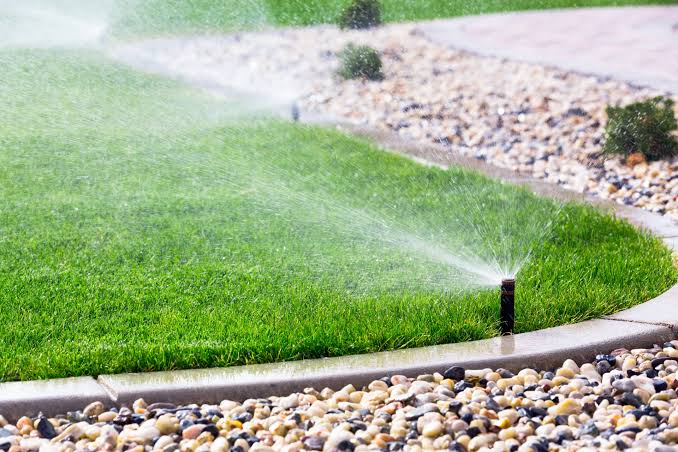
It's the most-asked question in all of lawn care, and the most misanswered: how much should I actually water? Neighbors say every day. The old advice says twenty minutes a zone. The water bill says less, the August heat says more — and the lawn itself keeps sending mixed signals. Meanwhile, the professional truth is that more North Texas lawns are damaged by wrong watering than by underwatering: fungus from soggy schedules, shallow roots from daily sprinkles, runoff bills from run times the clay can't absorb.
Here's the straight answer — the principles that govern lawn watering in this climate and soil, the numbers to start from, and how to read your own lawn's feedback instead of the neighbor's schedule.
Everything in lawn watering flows from one principle: water deeply and infrequently, not lightly and often. The reasoning is root behavior. Grass roots grow toward moisture — so a lawn watered daily and shallowly keeps its entire root system in the top inch or two of soil, because that's where the water always is. That lawn is permanently fragile: the surface layer dries in hours under Texas sun, and the shallow roots have no reserve to reach.
The same lawn watered deeply two to three times a week develops the opposite architecture: moisture driven down several inches pulls roots down after it, and the deep-rooted lawn drinks from soil reserves that persist between waterings — riding out hot stretches, missed days, and even watering restrictions with composure. The target that produces this: roughly an inch to an inch and a half of water per week in the growing season, delivered in two or three sessions rather than seven.
The tuna can test turns that target into run times for your actual system: set a few empty cans (or any straight-sided containers) around a zone, run it, and time how long it takes to collect half an inch. That's your session length for that zone — and it varies enormously by head type, which is why the twenty-minutes-everywhere folklore fails: rotor zones apply water slowly and may need forty-plus minutes for a real session, while spray zones deliver fast and may need under fifteen. Measure once, and your controller finally speaks your lawn's language.
North Texas adds a wrinkle the general advice misses: our clay soil absorbs water slowly — often more slowly than sprinklers apply it. Run a spray zone for its full session in one shot and the ground accepts the first minutes, saturates at the surface, and sheds the rest to the curb. You watered correctly and still shorted the lawn.
The fix is cycle and soak: split each deep session into two or three shorter cycles spaced about an hour apart. The first cycle wets the surface; the pause lets it soak downward; the next cycle pushes moisture deeper instead of pushing runoff to the street. Same total minutes, dramatically more of them delivered — and most modern controllers program it directly. If you see water streaming off the lawn during any cycle, that zone is telling you its runs are too long undivided.
Timing has one right answer: early morning, finishing by mid-morning. Pre-dawn starts soak in with minimal evaporation, and the grass dries as the sun rises — closing the overnight-wetness window that breeds fungus. Evening watering, the popular alternative, leaves blades wet all night; it's the standing invitation for brown patch, and it's why the disease so reliably visits the lawns of night waterers every spring and fall.
The seasons then move the volume: spring wants the light end of the range, ramping as heat builds — with rain doing real work that a functioning rain sensor should be crediting. Summer runs the full inch-and-a-half target through the peak, with cycle-and-soak earning its keep on every zone. Fall steps back down as temperatures moderate — the most-missed adjustment of the year, and the source of countless soggy October lawns running July schedules. Winter drops to minimal: dormant lawns need only occasional deep drinks during extended dry, mild spells, and the system spends freeze nights better empty than scheduled.
The lawn grades your watering continuously, if you know the signals. Underwatering shows as a dull blue-gray cast, blades folding lengthwise, and footprints that linger in the turf instead of springing back — the cues to water today. Overwatering shows as ground that squishes days after a session, moss and mushrooms colonizing, nutsedge thriving, and fungus circles in the damp seasons — the cues to cut back. And localized symptoms — one dry crescent, one soggy strip — usually aren't schedule problems at all: they're delivery problems, a head or zone failing, which no controller adjustment fixes.
That last point is the honest boundary of every watering guide: the best schedule in Texas only works if the system underneath it delivers — every head covering, every zone at pressure, no leaks rewriting the plan underground. The schedule is the strategy; the system is the execution — and keeping the execution honest is what seasonal irrigation maintenance is for.

Pair the right schedule with a system that actually delivers it. Kangaroo Outdoor Solutions provides complete irrigation maintenance and repairs — coverage checks, seasonal programming, and every zone tuned to water your lawn the way this climate demands. Build your quote today and get the watering question answered for good.