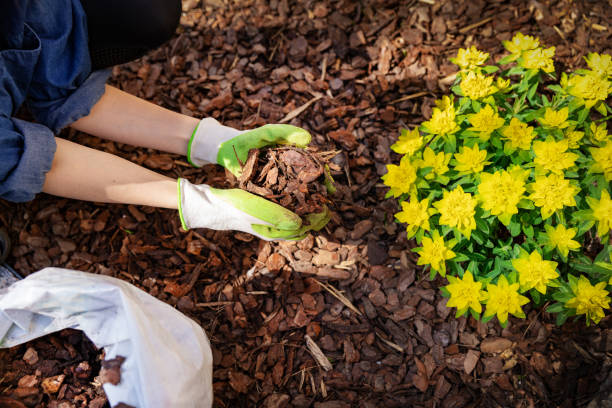
Everything mulch does in its first season is visible: the fresh look, the weed suppression, the moisture holding through summer. But mulch's most valuable work happens on a longer clock, out of sight, in a direction most homeowners never think about — downward. Organic mulch, refreshed annually, is quietly rebuilding the soil beneath your beds year after year: the slowest, cheapest, most reliable soil improvement program in all of landscaping, running as a side effect of a service you wanted anyway. Here's how it works, and why beds with years of mulch history grow visibly better plants.
Start with what most North Texas beds are working with. Beneath the plantings sits the regional inheritance: heavy clay — dense, fine-particled, low in organic matter, slow to drain, quick to compact. New construction beds are often worse: fill soil, biologically near-dead, that grows ornamentals the way pavement grows moss. Plants in that ground survive on the thin layer of decent soil that came with their root balls, roots reluctant to venture into the tight clay beyond — which is why so many shrubs sulk for years, growing but never thriving.
Fixing clay soil at scale sounds like a project — digging, amending, replacing. In established beds full of plants, it mostly isn't possible. Which is what makes the mulch route so valuable: it improves the soil from the top down, continuously, without disturbing a single root.
Here's the reframe: the way organic mulch breaks down isn't a product flaw — it's the soil improvement happening. From the day of installation, the bottom of the mulch layer is in contact with soil moisture and soil life, and it begins decomposing: fungi and bacteria breaking the material down, insects and earthworms carrying fragments downward, the layer converting itself, month by month, into dark, rich organic matter that works into the soil surface.
That organic matter is exactly what clay lacks and exactly what transforms it. Organic particles wedge between clay's tight plates, opening the structure — creating the pore space that lets water infiltrate instead of pooling, air reach roots, and roots penetrate ground that used to stop them. The biology compounds it: organic matter feeds the soil food web — the microbes and earthworms whose castings and channels aggregate clay into crumbs — so the soil doesn't just receive improvement, it starts manufacturing its own. Every year's mulch layer is a fresh delivery of raw material to that whole system.
The annual refresh is what turns a one-time benefit into a soil program. Each spring's installation replaces what last year's layer spent decomposing — so the surface protection stays constant while the underground deposits accumulate. Dig into a bed with five-plus years of mulch history and the evidence is right there in the shovel: a distinct upper layer of dark, crumbly, root-threaded soil — soil that wasn't there when the beds were new — sitting above the original clay, deepening slowly with every cycle.
Plants read that layer as habitat. Roots proliferate in the improved zone, plantings that sulked in raw clay establish and push, water behavior changes — beds absorbing irrigation that used to pool and run — and the whole system gets more drought-resilient as roots and structure deepen together. Gardeners have a saying that this process proves: feed the soil, and the soil feeds the plants. The annual mulch installation is that feeding, on a schedule.
A few choices maximize the long game. Material matters: shredded hardwood and similar organic mulches are the soil-builders — they're supposed to decompose; that's the feature. Inorganic alternatives like rock hold their looks but contribute nothing downward, and actually heat the soil they cover — a real trade-off worth knowing before choosing them for planted beds. Depth discipline matters: the standard two to three inches feeds the soil steadily without the suffocation of over-piling, and the annual refresh replaces rather than endlessly stacks. And the proper installation practices carry the program: trunks kept clear, beds prepped clean, the new layer laid where it can do its slow work.
None of it requires anything extra — just the spring mulch installation, done right, repeated. The transformation is patient: not this season, but every season, the ground under your beds getting darker, looser, and more alive. The fresh look is what you buy in April. The soil is what you've been building all along.

Start your beds' long game. Kangaroo Outdoor Solutions provides complete spring mulch installation — quality organic mulch, proper prep and depth, and the annual rhythm that rebuilds your soil year after year. Build your quote today and let every spring make your ground better.