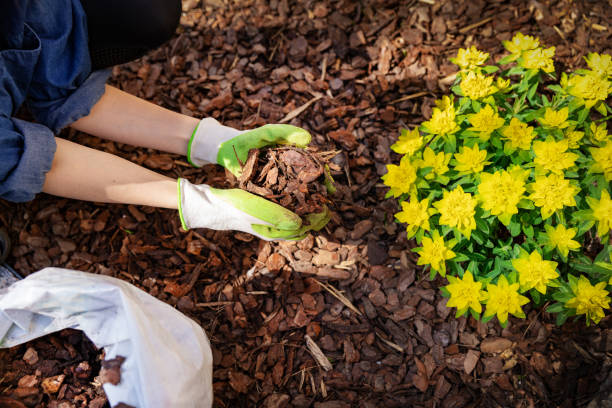
Here's a question that stumps more homeowners than it should: how old is the mulch in your beds? Most people can't answer — the mulch went in at some point, it's still visibly there, and "still there" gets mistaken for "still working." But mulch is a consumable, not a permanent fixture. It spends itself doing its job, and there's a real difference between beds that have mulch and beds whose mulch is actually functioning.
So here's the honest answer to how often mulch needs replacing, the signs that tell you yours is spent, and why the annual spring refresh became the professional standard.
For organic mulch — the shredded hardwood and similar materials in most Texas beds — the working standard is an annual refresh, ideally in spring. Not necessarily a full removal and replacement: most years, the job is topping the beds back up to full working depth over what remains of last year's layer, which has partially decomposed into the soil below.
That once-a-year rhythm isn't arbitrary. It matches how fast mulch actually spends itself in our climate — and understanding that spending is what makes the schedule make sense.
Mulch performs three jobs, and all three depend on one measurement: depth. At two to three inches, the layer blocks the sunlight most weed seeds need to germinate, slows the evaporation that empties bed soil in summer heat, and insulates root zones against temperature swings. Below about two inches, every one of those functions starts failing — light reaches soil, moisture escapes, and the beds gradually stop being protected.
And depth is exactly what mulch loses, continuously, from the day it's installed. It decomposes — the organic material breaking down into the soil below, which is genuinely a feature, since that decomposition is slowly feeding and improving your bed soil, but it consumes the layer doing it. Texas heat and moisture run that decomposition fast. The layer also settles and compresses under rain, loses material to wind and washing, and gets scattered by every season of activity in and around the beds.
The result: a proper three-inch spring installation is commonly down to a functional inch or so by the following spring. It still looks like mulch from the porch. It stopped doing mulch's job months ago — which is precisely when the beds got mysteriously weedier and the plants got thirstier, and nobody connected it to the gray layer underfoot.
You don't have to guess. The spent layer announces itself four ways:
The color is gone. Fresh organic mulch weathers from its rich brown or installed color toward pale silvery gray within months of sun exposure. Color alone is cosmetic — but a fully gray bed is also almost always a thin bed, because the fade and the decomposition run on the same clock.
The depth test fails. The definitive check takes ten seconds: push your fingers into the layer and measure what's actually there. Two inches or more of loose material means the layer is still working. An inch of crumbly, soil-like residue means the mulch has mostly become dirt — good for the soil, done as a barrier.
The weeds are back. Beds that stayed clean last summer and grew weedy this year usually haven't been invaded by anything new — the light barrier thinned below effectiveness, and the germination windows opened. Rising weed pressure in a mulched bed is the layer resigning.
Bare patches are showing. Soil visible through the mulch anywhere — along edges, in high-traffic spots, where water flows through the bed — means the barrier has holes, and every hole is a weed nursery and an evaporation vent.
The annual refresh could technically happen anytime, but spring timing captures every benefit at its maximum. The restored depth goes down before summer heat starts pulling moisture from the soil — protection in place ahead of the season that tests it, not scrambled into place after plants are stressed. The light barrier is rebuilt right before the warm-season weed germination surge, paired with pre-emergent on the cleaned soil beneath for the stacked defense. And the fresh look arrives at the start of the outdoor season, when the property is used and seen the most — the one-day visual transformation timed for the months it matters.
A proper refresh is also more than dumping new material on old: the beds get weeded completely first, debris cleared from plant crowns, edges re-cut, and the new mulch installed to a true two-to-three-inch total depth — never piled deeper over years of accumulation, which suffocates roots, and always pulled back from trunks and stems rather than volcanoed against them.
The honest math of deferral: skipping the refresh doesn't save the year's mulch cost — it trades it for the year's consequences. Thinning mulch means a summer of higher water demand on every bed planting, a weed invasion that monthly maintenance now has to fight uphill, and beds that spend the property's most visible season looking tired. And year-two neglect compounds: by the time a two-year-old layer gets addressed, the refresh has become a restoration — full weeding of an established invasion, more material to rebuild depth from nearly nothing.
The annual spring rhythm keeps it simple: one scheduled visit, the layer restored, the defenses rebuilt, the look reset — and the beds working, not just mulched, for another full year.

Is your mulch working or just present? Kangaroo Outdoor Solutions provides complete spring mulch installation — beds prepped, edges cut, proper depth restored, and the whole refresh handled in one visit. Build your quote today and get your beds back on the annual rhythm.