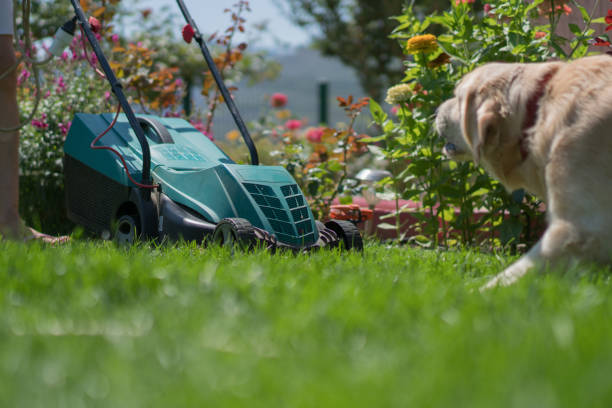
For dog owners, hiring lawn maintenance comes with a set of questions that have nothing to do with grass: What happens with the gate? Does the dog need to be inside on service day? Will the crew actually latch everything behind them? And underneath those, the turf question every dog household knows: can any service keep a lawn nice when a dog is actively using it as a racetrack, bathroom, and excavation site?
The answers are better than most dog owners expect. Here's how professional lawn maintenance actually works for homes with dogs — the logistics, the communication, and what the weekly rhythm does for a lawn living with paws.
Start with the item that matters most, because for dog owners it's non-negotiable: the gate. A professional service treats gate security as a standing protocol, not a courtesy — gates closed and latched behind the crew, every visit, without exception. It's one of the first details established when service begins: which gates exist, which stick, which latch needs the lift-and-push, and what the dog situation is on the other side.
This is also where crew consistency earns its keep for pet households specifically. The same crew servicing your property every week knows your dog exists, knows the gate quirks, and runs the protocol by habit — versus a rotating cast learning your yard fresh each visit. When you're evaluating any service as a dog owner, ask two questions directly: is it the same crew each week, and what's your gate policy? The answers tell you nearly everything.
The day-to-day logistics are simpler than most owners expect. The standard arrangement: dogs stay inside during the service window — for everyone's comfort and safety, since mowers and trimmers are loud, fast, and no place for an excited dog — and the predictable schedule makes that easy. A reliable service arrives on a consistent day with communication around timing, so the dog's indoor hour is plannable rather than a daily guessing game. Owners who work from home let the dog out after the crew leaves; owners who don't simply build service day into the routine.
One honest courtesy runs the other direction: picking up after the dog before service day. Crews work through whatever the lawn holds, but waste on the turf slows the visit, ends up on equipment, and gets spread by mowing — a quick patrol the night before keeps the service clean and fast, and it's the single thing crews most appreciate from dog households.
Now the turf itself — because dog lawns face real pressure, and the weekly maintenance rhythm is genuinely the right tool for it.
Dogs concentrate wear: the fence-line patrol route, the door-to-yard sprint path, the favorite corner. Those traffic lanes are exactly where turf thins first — and the weekly discipline of proper mowing height fights back directly, since taller, denser turf takes paw traffic dramatically better than scalped grass. A crew that knows the property mows to protect the wear zones, and trained weekly eyes flag the lanes that are losing ground while recovery is still a matter of routine care rather than repair.
The weekly visit is also the early-warning system for the dog-specific problems: the digging that started by the back fence, the spots appearing from concentrated wear, the fire ant mound that went up in the play zone this week — the things a dog household urgently wants to know about, spotted within days instead of discovered by the dog. And the consistent cut itself serves the household: short, regularly mowed turf means fewer fleas and ticks harboring in tall grass, less debris riding into the house on fur, and a yard that's simply more usable for the animal who uses it most.
No maintenance schedule makes a lawn dog-proof — a determined digger or a big dog's daily patrol will always leave some signature, and the fence-line path on a two-Lab household is a fact of life, not a service failure. What the maintenance rhythm does is keep the signature small and the rest of the lawn thriving: dense turf that absorbs the traffic, problems caught at patch size, and the seasonal services — the feeding that thickens, the aeration that unwinds the compaction dogs genuinely contribute — rebuilding what the paws take. Dog lawns on a program look like lawns with a dog. Dog lawns without one look like dog runs.
For the household, the sum is simple: the gate handled, the schedule predictable, the crew consistent, and a lawn that stays genuinely nice while doing its real job — being the dog's favorite place on earth.

Get a lawn service that works with your whole household. Kangaroo Outdoor Solutions provides weekly and bi-weekly lawn maintenance — consistent crews, secure gates, and turf care built for real family yards. Build your quote today and keep the yard great for everyone on four legs and two.