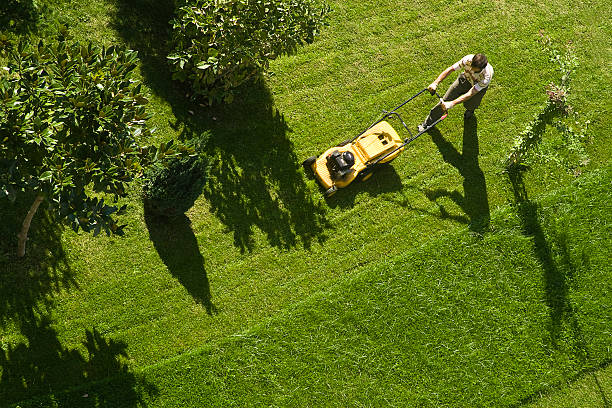
Of all the settings on all the equipment involved in lawn care, none does more quiet work than one lever most people have never touched: the mower's deck height. That single adjustment influences your lawn's drought tolerance, weed pressure, root depth, disease resistance, and color — every week, all season, for free.
And most lawns are cut wrong. Usually too short, occasionally too shaggy, almost always at one unchanging height from March to November as if the lawn's needs never move. Here's the complete mowing height guide: the right range for each Texas grass, how the number should shift with the seasons, and the handful of height-related rules that separate thriving lawns from struggling ones.
Grass blade length isn't cosmetic — it's the lawn's entire energy and defense system in one dimension:
Every grass has a range it's built for — and the ranges differ enough that knowing your grass type is step one:
Bermuda is the grass that can be cut short — it's the sports-field and fairway species — and common Bermuda lawns live comfortably in roughly the 1 to 2 inch zone, with hybrid varieties tolerating lower. But "can" isn't "should" for home lawns: most residential Bermuda looks and performs best at the upper half of its range, especially in summer. The practical guidance: maintain around 1.5 to 2 inches in the mild months and 2 to 2.5 inches through the heat. Bermuda's density and aggression reward the taller setting with fewer weeds and better drought rides
St. Augustine is the opposite personality: a broad-bladed grass that must be cut tall — roughly 2.5 to 4 inches — and punishes short cutting harder than any Texas grass. Its energy lives in those big blades and surface runners; scalp it and you've removed the plant's engine while exposing the stolons that can't regrow from underground backup. Chronically short-cut St. Augustine thins, browns, and gets overrun. Run it at 3 to 4 inches in summer — the tall end is its happy place, and the plush look is the point
Zoysia takes the moderate lane — roughly 1.5 to 2.5 inches for most common varieties — leaning taller in summer. Its extreme density holds shape well at height, and its slow growth means the setting drifts less between mows. The Zoysia-specific caution: its stiff, dense canopy punishes infrequent mowing more than the others — let it get away and the catch-up cut leaves brown stemmy scalping. Keep the rhythm, keep the middle heights
Here's the practice that separates professional maintenance from set-and-forget mowing: the deck moves with the calendar.
Whatever your grass and season, three companion rules make any height work:
Walk out and look: can you see soil, stems, or brown crowns through the grass right after mowing? You're cutting too short. Does the lawn flop, mat, or shade itself into thin spots? Too tall or too infrequent. Do brown tips appear a day or two after every mow? Blades, not height. And if the answer is "I have no idea what height it's set to" — that's the most common answer of all, and the easiest fix in lawn care: one lever, thirty seconds, and every week after that the lawn gets a little more of everything it needs.

Or skip the lever entirely. Kangaroo Outdoor Solutions mows every lawn at the correct height for its grass type and the season — raised for summer, adjusted through the year, with sharp blades and the one-third rule on every visit. Build your quote today and get the height right, automatically.