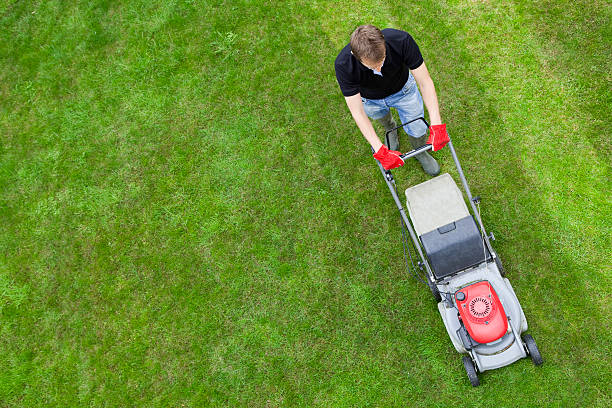
You've seen it — the lawn with crisp, alternating light-and-dark stripes running across it like a ballpark outfield, sitting on an ordinary street next to ordinary yards. It stops people mid-walk. It makes neighbors ask questions. And it creates the impression, accurately, that somebody who knows what they're doing takes care of that grass.
Here's the good news: lawn striping isn't magic, paint, or a special grass. It's light, direction, and technique. And beyond the looks, the habit behind striping — deliberately varying your mowing pattern — is one of the healthiest things you can do for turf. Here's how mowing patterns actually work, why professionals rotate them, and what it takes to get the striped look on a Texas lawn.
Those stripes aren't different grass colors. They're the same grass bent in different directions.
When a mower passes over turf, it bends the blades slightly in the direction of travel. Grass bent away from you reflects more sunlight off the full length of its blades — appearing lighter and brighter. Grass bent toward you shows more shadowed tips — appearing darker and richer. Mow in alternating directions, and you get alternating light-dark bands. Walk to the other end of the lawn and look back, and the stripes swap shades — proof it's all reflection.
That's the entire trick. Everything else is technique:
Honesty before ambition: striping showcases best on cool-season grasses (the soft fescues and ryes of northern lawns and stadiums) because their flexible blades bend and hold beautifully. Texas warm-season grasses are stiffer customers:
So set expectations by grass type — and know that even where stripes come out subtle, everything else in this article still pays off fully. Which brings us to the real point.
Here's what separates professional mowing from simply pushing a mower the same way every Saturday: pros never mow the same direction twice in a row. The stripes are a bonus; the rotation is the substance. Repeating an identical route week after week causes three cumulative problems:
Mower wheels tracking the exact same lines every week press those strips of soil harder with every pass. Over a season, that's visible wheel ruts and compacted lanes where turf thins and water sheds — permanent stripes of the bad kind. Rotating patterns distributes wheel traffic across the lawn, so no line takes the repeated load.
Turf mowed the same direction continuously develops grain: blades that permanently lean one way, like combed hair. Grained turf mows unevenly (the mower rides over leaning blades instead of cutting them cleanly), looks flat, and develops a swirled, matted appearance. Alternating direction stands the grass back up each week — every pass counter-bending the last — producing the upright, uniform, carpet-dense look people associate with professional care.
Blades leaning away from the mower get missed or half-cut; standing blades get sliced cleanly. Rotation ensures every part of the lawn gets attacked from a fresh angle regularly, so the whole surface cuts even.
The professional rotation is simple: change the pattern every mow. Horizontal this week, vertical next, diagonal after — a four-week cycle that never repeats consecutively. It's a zero-cost habit with compounding results, and its absence is visible in any lawn that's been mowed on autopilot for a season.
Want to chase the striped aesthetic on your own lawn? The craft checklist:
Here's the honest summary of why striped lawns impress people: the stripes themselves are minutes of extra technique — but they only show up on turf that's already healthy, dense, properly heightened, cleanly cut, and consistently maintained. The pattern is the signature on work that was already done right. That's exactly why professionally maintained lawns tend to have that look: crews mowing weekly, rotating patterns as standard practice, running sharp commercial blades at correct seasonal heights, and finishing every visit with edges and cleanup. The stripes aren't the service. They're the evidence.

Want the lawn people slow down to look at? Kangaroo Outdoor Solutions delivers professional weekly lawn maintenance — proper heights, sharp blades, rotating patterns, crisp edges, and full cleanup every visit. Build your quote today and let your lawn do the showing off.