Leaf Removal for Large Properties, Acreage, and Pastures: Handling Fall at Scale

November 18, 2024

Suburban leaf advice falls apart fast on a big property. "Rake weekly" is charming guidance for a quarter-acre lot; it's comedy for five acres under mature oaks and pecans, where a single fall weekend can drop more leaf volume than a suburban lawn sees in a decade. Large lots, homesteads, and properties with pastures face leaf season as a genuinely different problem — different volumes, different stakes, different tools — and it deserves its own playbook.

Here's how leaf removal actually works at scale: what heavy leaf cover does to big turf and pasture ground, how professional crews handle acreage, and how to structure a plan that fits your property instead of a suburban template.

The Scale Problem, Honestly Stated

Mature hardwoods are prodigious: a single big oak or pecan drops a genuinely enormous volume of leaves each fall, and large properties don't have one — they have canopies. Multiply that across weeks of staggered drop (different species on different schedules, live oaks holding into late winter), and the defining feature of large-property leaf season emerges: the volume never arrives all at once, and it never stops arriving. The one-Saturday cleanup model was never going to work here — the property re-buries itself before the bags are hauled.

Meanwhile the stakes scale with the acreage:

  • Turf zones smother at scale. The same time-on-ground damage that kills suburban lawn patches — light blocked, moisture trapped, fungus incubated — happens across whole swaths of big-lawn ground, and re-establishing large areas of turf is expensive in proportion
  • Pastures have their own case. Heavy matted leaf cover on pasture ground suppresses the grass beneath it exactly as it does turf — shading out the forage and leaving thin, mud-prone patches — which is why pasture leaf cleanups are a real and recurring service on treed acreage, not an eccentric request
  • Drainage runs longer. Big properties move water across culverts, swales, and long grades — and leaf dams in those paths turn the first serious winter rain into erosion and standing water at scale
  • Fire and pest accumulation. Deep leaf drifts against structures, fence lines, and outbuildings are dry-season tinder and year-round habitat — housekeeping that matters more when the property has more edges to accumulate against

How Crews Handle Acreage: The Equipment Answer

Large-property leaf removal is where commercial equipment stops being a convenience and becomes the entire feasibility of the job:

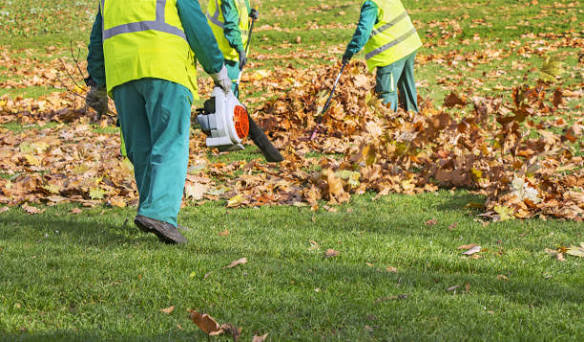
  • Commercial backpack and wheeled blowers move leaf volume that makes homeowner gear irrelevant — herding acreage-scale drifts in coordinated sweeps, lifting wet matted layers off turf and pasture ground
  • The formation sweep is the method: multiple operators working as a moving wall, consolidating leaves across big open ground in single directional pushes — every leaf moved once, toward collection points, instead of chased in circles
  • Bulk collection and haul-off replaces the bag economy entirely. At acreage volumes, bagging isn't slow — it's impossible; tarp-and-trailer bulk handling with full haul-off is the only version of the job that finishes. (No burn-pile management, no leaf mountain composting itself by the gate)
  • Mulch-mowing takes a share where it can. On the maintained turf zones, mowing passes chop what's within mulching capacity back into the ground as free organic matter — the volume threshold rule applied honestly, with removal handling everything past it

Structuring the Plan: Zones and Timing

Like all large-property maintenance, the leaf plan works best zoned:

  • The home zone — the lawn, beds, and outdoor living areas around the house — gets suburban-standard protection: leaves cleared repeatedly through the drop so nothing mats, beds and corners included, the areas you see daily kept genuinely clean
  • The open acreage and pastures get scheduled sweeps timed to accumulation: typically recurring visits through the drop season for heavy-canopy ground, clearing before layers mat and smother, with a final late-season pass taking the stragglers and the late oaks
  • The infrastructure pass rides along every visit: fence lines, culverts, drainage paths, and structure perimeters dug out — the edges where drifts build and problems start

The frequency question answers itself by canopy: genuinely heavy tree cover wants the multi-visit rhythm (the monthly model, scaled up); lighter-treed acreage may do fine with one or two big well-timed sweeps. What large properties should not do is the thing suburban habits suggest — wait for the drop to "finish" while the first two months of leaves mat over the turf and pasture ground underneath.

The Trade at Scale

Here's the large-property version of the leaf-season math: at acreage volumes, DIY leaf work isn't a weekend chore — it's a recurring multi-day operation requiring equipment most homeowners don't own, ending in a disposal problem most properties can't absorb. Professional removal at scale compresses each round into hours, includes the haul-off that makes it actually done, and protects turf and pasture ground whose re-establishment would cost multiples of the service. Big properties are glorious in October. The plan is what keeps them that way in April.

Got acreage under all those trees? Kangaroo Outdoor Solutions handles leaf removal at scale — lawns, pastures, fence lines, and drainage, with commercial equipment and haul-off included, on the schedule your canopy actually needs. Build your quote today and take leaf season off the acreage to-do list.