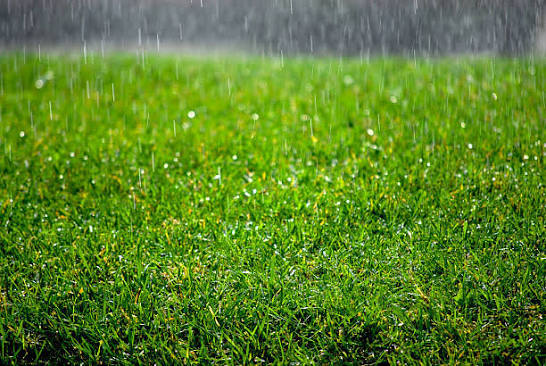
Every North Texas spring runs the same cruel experiment: weeks of rain that make the grass grow faster than at any other time of year, combined with ground too wet to mow. The lawn surges an inch or more a week; the mower sits in the garage; and by the time a dry window opens, the yard has transformed from "maintained" to "meadow" — right as the neighborhood is at its most visible.
Rainy-season mowing is a genuine skill problem, not just a scheduling annoyance. Mow too wet and you rut the yard, clump the clippings, tear the grass, and spread disease. Wait too long and the catch-up cut violates every rule of healthy mowing. Professional crews navigate this gauntlet every spring with a specific set of judgment calls and techniques — and understanding them helps whether you're mowing yourself or evaluating how your service handles the wet weeks.
Here's the complete wet-season playbook: what mowing wet grass actually does, how to judge "too wet," the catch-up protocol when the lawn gets away, and how good maintenance schedules absorb rain delays without the lawn ever showing it.
"Don't mow wet grass" is folk wisdom with real mechanics behind it. The specific damage, in order of severity:
Saturated soil has almost no structural strength — and a mower crossing it presses wheel tracks into the ground that can persist for the rest of the season. Worse, in clay soil, every wet-ground pass is a compaction event: the soaked clay compresses under the wheels far more than dry ground would, and that compression stays. A lawn mowed soggy a few times a spring accumulates real soil damage — the kind that later shows up as thin wheel-line stripes and requires aeration to undo. This is the number-one reason professionals delay: not the grass, the ground.
Wet grass blades are soft, heavy, and flattened — they bend away from the blade instead of standing to be cut, so the mower tears and bruises rather than slicing. The result appears a day later: ragged, browning tips across the lawn, the shredded look that reads as disease. Wet cutting is rough on the turf even when the ground can bear the machine.
Wet clippings don't disperse — they wad into heavy mats that drop in clumps across the lawn, smothering the grass beneath each one. A clumpy wet mow leaves the lawn polka-dotted with yellowing patches a week later, and the cleanup (raking or double-mowing to disperse) adds work the dry mow never required.
The rainy season is also fungus season — brown patch and its relatives thrive in warm, wet stretches — and a mower moving through wet, infected grass carries pathogen from sick zones to healthy ones on its deck and blades. Dry conditions break that transmission chain; wet mowing during an active outbreak accelerates it.
Wet grass cakes mower decks (dulling performance and breeding rust), stains everything it touches, and produces the throw-mat of soggy clippings across driveways and walks that no blower fully fixes. Minor sins compared to the rest, but part of why wet mows never look finished.
"Wet" is a spectrum, and the professional call has layers:
Sometimes the rain wins — ten days of storms, and the Bermuda that needed cutting at day seven is now ankle-high at day twelve. The overgrown lawn cannot be fixed in one pass without breaking the one-third rule catastrophically, so the professional protocol is staged reduction:
The tempting alternative — one dramatic cut back to normal height — scalps the lawn at the worst possible moment: stressed plants, exposed crowns, opened soil, all during prime weed-germination and fungus weather. The staged protocol takes a week longer and costs the lawn nothing. This is also, frankly, one of the places professional service proves its value: crews run the catch-up protocol by habit, while the DIY instinct after a rain delay is almost always the single revenge cut.
Here's what separates professional maintenance from weather-hostage mowing: the rain plan is built into the operation.
The result, across a wet spring: the maintained lawn shows almost nothing. Visits shift a day here and there, heights flex, the catch-up protocol deploys once in the worst stretch — and the lawn never has the meadow week, the rut stripes, or the scalped recovery that the weather-hostage yards all around it wear until June.
Two closing notes for perspective. First, the same rain causing the scheduling chaos is doing your irrigation budget an enormous favor — wet stretches are when smart watering means not watering, and a rain sensor or attentive controller management captures weeks of free soil moisture. Second, the surge itself is opportunity: the fastest-growing weeks of the year are when a fed, properly mowed lawn builds density at maximum speed. The rainy season is the growth engine of the whole year — the entire game is keeping the maintenance rhythm intact through it, so all that growth compounds into turf instead of into catch-up work.

Let the weather be our problem. Kangaroo Outdoor Solutions runs rainy-season maintenance the professional way — make-up scheduling, ground-condition judgment, staged catch-up cuts when needed, and clear communication through it all. Build your quote today and keep your lawn sharp through every wet spring.