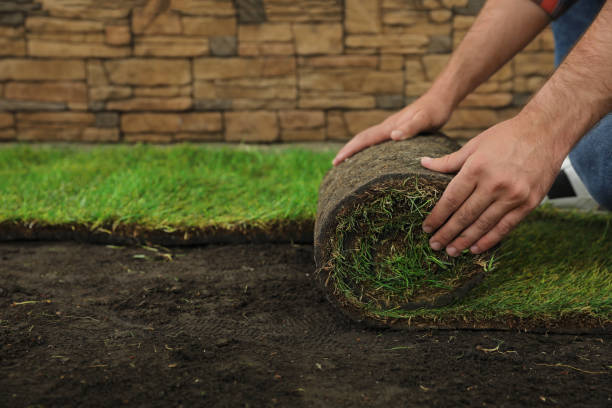
New sod is the most expensive grass you'll ever own and the most fragile it will ever be — at the same time. Those fresh green rectangles arrive as living plants that have just had most of their roots cut off at the farm, and for the next several weeks they survive entirely on what you do next. Care for sod correctly through its first month and it knits into a permanent lawn; get the first two weeks wrong and you can kill an entire installation before it ever had a chance.
The good news: new sod care isn't complicated — it's specific. A watering schedule that changes week by week, a first mow with rules attached, and a short list of things not to do. Here's the complete 30-day playbook.
Understand the situation and every rule below makes sense: harvested sod is turf with a severed root system — an inch or so of roots and soil supporting a full canopy of grass. Until those roots regrow down into your soil, the sod cannot reach moisture below itself. It's living on the thin layer it came with, which dries out in hours under Texas sun.
The entire first month is one mission: keep the sod alive on surface moisture while it re-roots, then progressively wean it onto deep watering as the roots take hold. Every week's care follows that arc.
Day one starts immediately — new sod should be watered within a half hour of installation, and the first soaking should be generous: enough that the sod and the top inch of soil beneath it are thoroughly wet (lift a corner and check — the underside should be visibly moist, the soil under it darkened).
Through week one, the rule is never let it dry out: typically multiple short watering sessions per day (morning and midday at minimum, more in serious heat), keeping the sod consistently moist — not swampy, but never crisp. The corner-lift check is your instrument: moist underside and damp soil beneath means you're on target; dry edges, gaps opening between pieces, or blades going gray-blue and wilted mean increase immediately. Edges and seams dry first — give borders, curb strips, and pieces along pavement extra attention, because reflected heat cooks them fastest.
And stay off it. No foot traffic, no pets, no anything — the pieces shift, the surface ruts, and the fragile new root connections shear.
Somewhere early in week two, the most encouraging test in lawn care starts to pass: the tug test. Grab a handful of sod and pull gently — resistance means roots are grabbing your soil. As rooting progresses, the watering evolves:
Somewhere in the week-two-to-three window, the sod will need its first cut — and the first mow has protocol:
From there, regular mowing at proper height actually helps establishment — it encourages lateral spread and density.
By the end of the first month, well-managed sod is rooted, mowable, and ready to join the regular program:
The autopsy list, from most common down:
Here's the closing truth about sod: the installation is the purchase; the first month is the survival; and the first full year is the establishment. A lawn sodded this season repays proper mowing, correct watering, timely feeding, and its first aeration-and-program year with decades of turf — and repays neglect with the most expensive bare spots you'll ever re-buy. The thirty-day playbook gets it alive; the maintenance rhythm makes it permanent.

Just sodded — or planning to? Kangaroo Outdoor Solutions can run the whole establishment: irrigation programming for every stage, first mows done right, and the year-round program that turns new sod into a permanent lawn. Build your quote today and protect the investment from day one.