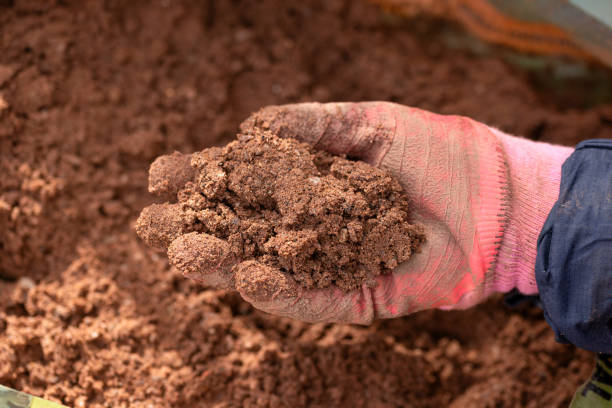
Every gardener and homeowner in North Texas eventually has the moment: a shovel bounces off summer ground like it hit concrete, or a post-hole project turns up slick orange-brown ribbons that smear like pottery clay — because that's essentially what they are. The soil under most of our lawns isn't dirt in the friendly, crumbly sense. It's expansive clay, one of the most challenging soil types in American landscaping, and it is quietly involved in almost every lawn problem this region has.
Understanding your clay isn't academic. It explains why your water runs off, why your lawn thins despite good care, why aeration gets recommended so relentlessly here, why foundation companies stay busy, and why advice written for sandy Florida or loamy Midwest soils keeps failing in your yard. Here's the complete owner's manual for North Texas clay: what it actually is, the specific ways it fights turf, and the strategy stack that wins anyway.
Soil is classified by particle size, and clay sits at the extreme end: particles so microscopically fine that they pack together with almost no space between them. Sand particles are boulders by comparison, stacking loosely with big gaps that water and air move through freely. Clay particles stack like wet sheets of paper — dense, tight, and nearly airless when compressed.
Much of North Texas sits on clay-dominant soils — including the famous blackland clays to the east and the mixed clay soils across Parker County and the western DFW area — often with limestone not far beneath. For lawns, three properties of this ground define everything:
It's slow to absorb. Water enters clay at a fraction of the rate it enters sandy soil. Rain and irrigation arriving faster than that absorption rate don't soak in — they sheet across the surface and leave, which is why North Texas lawns can be simultaneously overwatered by the sprinkler bill and underwatered at the root zone.
It compacts brutally. Those fine particles press together under any repeated force — foot traffic, mower passes, even the impact of rain — and once compressed, clay holds the compression. Compacted clay approaches pavement: nearly impermeable to water, nearly airless for roots, and physically resistant to root penetration. Every lawn on clay is compacting continuously, all the time, by default.
It swells and shrinks dramatically. Expansive clay absorbs water into its particle structure and physically grows — then shrinks as it dries. Wet winters swell it; drought summers shrink it until the ground opens visible cracks. This is the movement that torments foundations across the region, and it stresses everything rooted in the soil through every wet-dry cycle.
And one genuinely redeeming feature deserves its credit: clay is nutrient-rich. Those same fine particles hold onto minerals and fertility that sandy soils let wash through. Clay's problem was never poverty — it's access. The nutrients are in the vault; the challenge is getting water, air, and roots through the door.
Translate those properties into the lawn problems you actually see:
Every watering session on tight clay pays a tax to the gutter. Standard sprinkler schedules — one long run per zone — routinely exceed clay's absorption rate within minutes, sending a meaningful share of your water (and your water bill) streaming to the curb while the root zone six inches down stays dry. The lawn shows chronic mild drought stress despite generous watering, and the homeowner responds with more watering, paying more tax.
Roots need oxygen and penetrable ground, and compacted clay offers neither below the top couple of inches. So turf on hard clay roots shallow by force — living in the thin workable layer at the surface, which is precisely the layer that bakes dry fastest in summer. The result is the signature North Texas lawn fragility: grass that looks fine in May and collapses in the first real heat stretch, because its entire root system occupies the ground's most vulnerable inch.
Compaction thins turf (roots can't run), thin turf exposes soil, exposed soil takes rain impact and traffic directly, and direct impact compacts it further. Left alone, clay lawns spiral: the trafficked areas go first (the path to the gate, the kids' goal-mouth, the strip cars cut across), then the thinning spreads. Weeds — many of which tolerate compaction better than turf — colonize each stage of the decline.
Clay drains slowly, so low spots and over-watered zones stay saturated for days — suffocating roots, breeding fungus, and rolling out the welcome mat for nutsedge and moss. The same yard can host drought-stressed turf on its compacted high ground and drowning turf in its soggy corner: clay punishes both directions at once.
The swell-shrink cycle works on turf roots the way it works on foundations — ground that moves, cracks, and re-compresses through every wet-dry swing is a hostile mechanical environment. It also periodically shears the fine roots trying to establish deeper, adding one more force pushing the root system to stay shallow.
Here's the good news: clay is beatable — not by changing the soil (you're not replacing the ground under a lawn) but by working with its rules. The professionals' stack, in order of leverage:
If clay has one antidote, this is it. Pulling thousands of soil cores does exactly what clay most needs: creates the pore space the particles won't provide. Water infiltrates through the channels instead of sheeting off, oxygen reaches the root zone, roots get physical corridors downward, and the compaction spiral gets interrupted at its source. On clay, aeration isn't an enhancement — it's the maintenance that keeps the ground functioning as soil. Once a year is the floor; spring and fall is the standard for lawns that get real use, because clay re-compacts continuously and the twice-yearly rhythm stays ahead of it.
Since clay drinks slowly, deliver slowly: split each watering into two or three shorter cycles spaced an hour apart. The first cycle wets the surface and starts absorption; the pause lets it soak; the next cycle pushes moisture deeper instead of pushing runoff to the street. Same total water, dramatically more of it delivered — and paired with the deep-and-infrequent schedule, it's how clay lawns finally build the deep moisture profile that carries them through summer. (This is also where rotor nozzles and irrigation tuning earn extra value on clay — slower application rates are clay's love language.)
Clay's structure improves as organic matter works into it: decomposing material opens the particle packing, feeds the soil biology that aggregates clay into crumbs, and over years genuinely changes the ground's behavior. The lawn-scale sources are the unglamorous routine ones — grasscycled clippings returning every mow, aeration cores crumbling back in, mulch decomposing into bed soil, and organic-input feedings. No single application transforms clay; five years of consistent organic return visibly does.
Dense turf is clay's surface protection: the canopy absorbs rain impact before it compacts the ground, the root mass holds structure, and full coverage keeps the compaction-tolerant weeds from getting their openings. Everything that builds density — proper mowing height, weekly frequency, the feeding program, the weed control that keeps competitors out — is also, quietly, soil defense.
And the honest edge cases: chronically soggy clay zones may need genuine drainage work (grading, downspout management, French drains) once irrigation causes are ruled out — and the swell-shrink cycle near foundations deserves consistent moisture management, which is a property-care issue bigger than the lawn but visible from it.
North Texas clay isn't going anywhere — it's the ground your lawn was dealt, with a real gift (fertility) locked behind real challenges (access, compaction, movement). The lawns that thrive on it aren't fighting the clay with willpower; they're running the stack: open the soil on schedule, water at the speed the ground can drink, feed the organic long game, and keep the living armor dense. Do that consistently and clay's vault opens — and the same ground that breaks shovels grows some of the best lawns in Texas.

Your lawn is only as good as what's under it. Kangaroo Outdoor Solutions runs the full clay-country playbook — spring and fall aeration, irrigation tuned for slow soils, and the maintenance that builds density year over year. Build your quote today and make your ground work for your lawn.