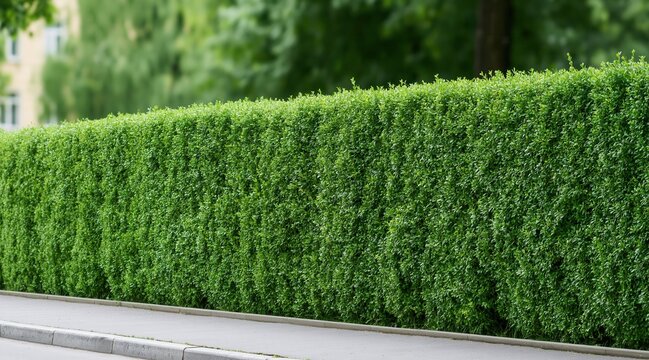
Somewhere along most property lines, there's a hedge with a job: block the view of the neighbor's boat, screen the patio from the street, wall off the AC units, turn a chain-link fence into something green. Privacy hedges are the hardest-working plants in the landscape — part fence, part architecture, part garden — and they succeed or fail on one quality above all: density. A hedge you can see through isn't a hedge; it's a row of shrubs with unfinished business.
And density is made, not bought. The fullest, most impenetrable living screens in any neighborhood got that way through years of correct trimming — while the gappy, leggy, see-through hedges nearby usually received more total cutting, done wrong. Here's the complete privacy hedge guide: how screens actually develop density, the trimming geometry that keeps them full to the ground, the common failure patterns and their fixes, and the maintenance rhythm that keeps a living wall living.
A privacy screen is a row of individual shrubs trimmed into behaving like one continuous plant — and the transformation runs on a simple biological lever: cutting a shoot's tip stimulates branching behind the cut. Every trim of the hedge's surface converts single shoots into multiple shoots; repeated across seasons, the multiplication compounds into the dense twiggy lattice that holds a solid face of foliage. This is why regular light trimming builds a hedge while benign neglect thins one: the untrimmed shrub grows tall and open, spending its energy on a few long shoots; the trimmed hedge is forced, cut after cut, to spend the same energy on density.
Two implications follow immediately:
Young hedges need trimming they seem too small for. The counterintuitive rule of establishment: new privacy plantings should be trimmed lightly from early on — even while you're desperate for height — because the branching structure built in years one through three is the framework the mature screen fills. The common mistake is letting young hedges race upward untouched to "get the privacy faster": you get height with hollow, leggy structure, and the screen never fully closes at the levels that matter. Patience at the start buys density forever.
The hedge is always either building or losing density. Screens on a regular trimming rhythm compound fuller; screens trimmed sporadically drift open between the panic cuts. Density is a maintenance dividend, paid quarterly.
Here's the single most important — and most violated — principle in hedge care: a hedge must be trimmed slightly wider at its base than at its top. The professionals' term is batter — the faces of the hedge sloping gently inward as they rise, like a very subtle pyramid.
The reason is sunlight. Foliage lives on light, and in a hedge trimmed straight-sided — or worse, wider at the top, which is exactly what casual trimming produces, since the top is easiest to over-cut narrow and the base easiest to under-reach — the upper growth shades the lower growth. Shaded hedge bases defoliate: leaves thin, twigs die, and the screen develops the classic failure — full and green up top, bare legs and see-through gaps at exactly the eye-level-and-below zone the privacy screen exists to block.
Battered geometry keeps the base in light, and the base keeps its foliage — the difference between a hedge that screens to the ground for decades and one that becomes a green canopy on bare trunks. Every trimming visit either maintains this geometry or erodes it; it's the first thing a trained eye checks and the first casualty of untrained shearing.
Privacy hedges run on the quarterly rhythm with hedge-specific priorities:
The privacy hedge problem catalog, diagnosed:
The see-through base. Cause: inverted geometry (top-heavy trimming) shading out the lower foliage — see the batter rule. The fix is honest: re-establish battered geometry and give the base seasons of restored light; recovery depends on species (the vigorous regrowers refill; the bare-wood-shy species may hold their gaps, and severe cases argue for underplanting or staged renovation)
The gap where a plant died. Screens are chains, and one dead shrub breaks the whole run. Fix: replace promptly with the same species — and diagnose the death first (drip emitter failure along hedge rows is a classic serial killer of screen plantings; check the irrigation before planting the replacement into the same problem)
The hedge that got away. The overgrown screen — too tall, too wide, swallowing the walk. Fix by species: the strong regrowers (ligustrum and kin) tolerate staged hard reduction (walking the hedge down over sessions, letting regrowth green each stage before the next); the shell-and-dead-interior types demand the patient multi-season approach — and the worst cases sometimes justify the honest math of replacement, where three years of awkward restoration competes with a new planting's clean establishment
The thin-from-the-start screen. Planted too far apart, or raced to height without early trimming — structure that never densified. Fix: begin the compounding now (regular trimming builds branching at any age), manage expectations on timeline, and consider infill planting in the gaps
Step back and the privacy hedge is the perfect argument for professional quarterly care in miniature: a planting whose entire value depends on technique (the batter geometry), timing (the seasonal pass structure), species knowledge (who tolerates what cutting), and rhythm (density compounds on schedule and erodes off it). A great screen is never one heroic trimming — it's forty consecutive correct ones, each unremarkable, adding up to a wall of green that does its job every single day for decades. That's what the quarterly program is actually selling: the compound interest.

Whether your screen needs building, rescuing, or just its next correct trim, Kangaroo Outdoor Solutions' quarterly shrub trimming maintains privacy hedges with the geometry, timing, and species knowledge that keep them dense to the ground. Build your quote today and keep your living wall solid.