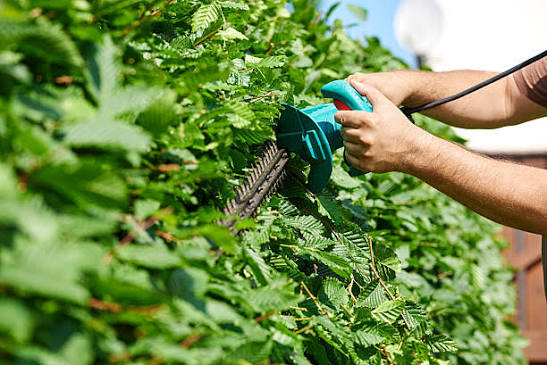
Look at any two well-kept landscapes and you'll notice they can be well-kept in completely different ways. One features crisp geometric hedges — flat-topped rectangles, tidy globes, formal lines. The other looks effortlessly natural — shrubs in soft, layered, organic shapes that seem to have grown that way (they didn't). Both look intentional. Both take skill. And they're produced by two fundamentally different trimming approaches.
Most homeowners never consciously choose between them — their shrubs just get whatever the last person with a hedge trimmer did, repeated forever. But the shearing-versus-natural decision shapes your landscape's entire character, changes what maintenance it needs, and — here's the part that matters most — isn't equally healthy for every plant. Here's the guide to both styles: what each involves, which shrubs suit which, and how to choose deliberately.
What it is: Shearing cuts the outer surface of a shrub to a defined shape — flat planes, globes, cones, hedges — using hedge trimmers that slice everything at the chosen line regardless of branch structure. It's surface sculpting: the plant becomes a green geometric solid.
What it delivers: Crispness. Sheared landscapes read formal, architectural, and controlled — clean hedge lines defining spaces, matched globes flanking an entry, the manicured symmetry that suits traditional and formal home styles. When the geometry is straight and the surfaces tight, nothing says "meticulously maintained" quite like it.
What it demands: Frequency and precision. Sheared shapes only look sharp when they're kept sharp — new growth fuzzes the geometry within weeks in the growing season, so formal shearing commits you to the most regular trimming schedule in the landscape (quarterly as the working minimum, with touch-ups on fast growers). And straightness is unforgiving: a wavy hedge top or a lopsided globe announces itself from the street.
The biology bill: Here's what every homeowner with sheared shrubs should understand. Shearing cuts stimulate dense branching right at the cut surface — which is exactly what creates the tight formal skin — but repeated over years, that response builds an ever-denser outer shell that blocks light from the plant's interior. Inside the crisp green box, branches defoliate and die back, leaving a hollow twiggy core with all living growth in the outer inch or two. The shrub still looks fine — until any cut goes past the shell, revealing the bare inside, or until the shell itself starts thinning with age. Managed shearing accounts for this: occasional selective openings that let light into the interior, keeping some inner growth alive as insurance. Unmanaged shearing — the buzz-the-surface-forever approach — slowly converts shrubs into fragile green facades.
What it is: Natural pruning works with the plant's structure instead of over it — using hand pruners and loppers to remove select branches back at junctions inside the canopy: dead and crossing wood out, overlong branches shortened to a side branch, density thinned so light reaches the interior. The shrub keeps (and refines) its species' natural shape — arching, mounding, layered, vase-form — just cleaner, sized, and healthier.
What it delivers: Grace and resilience. Naturally pruned landscapes read relaxed, established, and organic — the style that suits contemporary, cottage, native, and informal designs, and that lets flowering and textural shrubs actually show their character (an abelia's arching sprays, a nandina's layered canes) instead of being boxed into anonymity. It also delivers a quieter benefit: plants pruned this way are structurally healthier — light reaches interior growth, air moves through the canopy (a genuine disease-pressure reducer), and there's no dead-shell fragility. And because cuts are made to natural growth points, the look degrades gracefully between visits instead of fuzzing like broken geometry
What it demands: Knowledge over frequency. Natural pruning is slower, more skilled work per visit — every cut is a decision about structure — but the visits can be less frequent, because the shape doesn't collapse the moment new growth appears. The trade: it will never give you a razor-flat hedge line. That's not its job
Here's where the style decision stops being pure aesthetics — because species tolerance for shearing varies enormously:
Happy to be sheared: Dwarf yaupon holly (the meatball champion — genuinely thrives under shearing), boxwood (the formal classic — with the interior-light management above, since its bare-wood recovery is famously poor), ligustrum and privets (vigorous regrowers that shrug off constant cutting — the classic formal hedge stock)
Wants natural form: Abelia (shearing destroys its arching character and produces whiskery regrowth — prune by removing whole canes), nandina (never flat-top it — cut individual canes at staggered heights or it becomes bare stalks with pom-poms), crape myrtle (not a hedge, never topped — thinned selectively, always), and most flowering shrubs generally — because shearing removes flower buds indiscriminately, which is why sheared azaleas and hawthorns bloom in sad patches while naturally pruned ones bloom everywhere
The takeaway: the style menu is real, but the plant list constrains it. A landscape's trimming plan should be decided shrub by shrub — geometry where the species supports it, natural form where the species demands it — not by whichever single tool is in hand.
Practical questions that settle it:
And whichever way the decisions fall, the common denominator is the one this series keeps returning to: the right cut for the right plant on the right schedule. That's the actual definition of quality shrub trimming — style is the expression; species knowledge and consistency are the substance.

Formal, natural, or the smart mix — Kangaroo Outdoor Solutions trims every shrub with the right technique for its species and your landscape's style, on a quarterly schedule with complete cleanup. Build your quote today and give your landscape a look that's actually chosen.