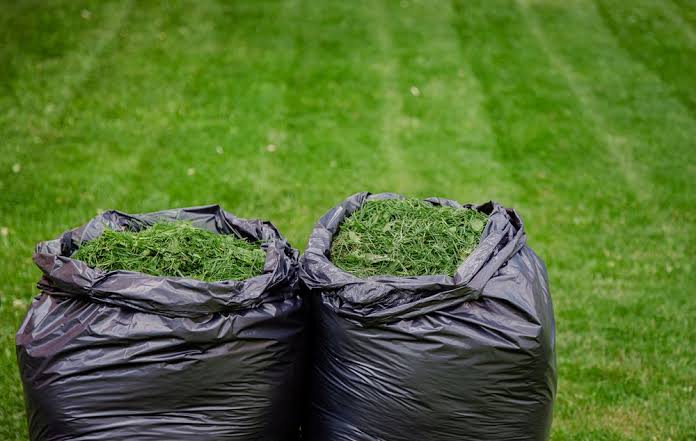
Every mowing season, homeowners spend hours doing something their lawn mostly wishes they wouldn't: stuffing grass clippings into bags. It feels tidy. It feels responsible. And for the majority of mows on the majority of lawns, it's throwing away free fertilizer while adding the most tedious chore in yard work.
But "never bag" isn't the right answer either — there are specific situations where bagging is genuinely the correct call, and knowing the difference is the whole game. Here's the honest guide to grass clippings: what they actually do when left on the lawn, the myths that keep people bagging, and the short list of times the bag earns its place.
Start with the composition, because it explains everything: grass clippings are mostly water — soft, nitrogen-rich blade tissue that decomposes fast. Cut at proper frequency, clippings are short fragments that filter down through the turf canopy, disappear from view within a day or two, and break down completely within weeks — releasing their nutrients right back to the lawn that grew them.
That return is not trivial. Clippings recycle a meaningful share of the nitrogen your lawn consumes — season after season, for free — along with organic matter that feeds the soil biology clay lawns badly need. The practice even has a name in turf science: grasscycling. A lawn that keeps its clippings needs measurably less supplemental feeding to hold the same color and density than one that exports its nutrients to the curb in bags.
The reason generations of homeowners bag religiously is one persistent belief: clippings cause thatch. It's repeated everywhere, and it's wrong.
Thatch — the spongy layer that builds between grass and soil — is made of the tough stuff: stems, runners, crowns, and roots rich in slow-rotting lignin. Soft, watery blade clippings decompose far too fast to accumulate; they're gone before thatch could ever form from them. The actual thatch drivers are aggressive spreading growth (Bermuda and Zoysia doing what they do), heavy nitrogen pushing, and compacted soil with weak decomposer biology — none of which the bag addresses. You can bag every clipping for a decade and still build thatch; you can grasscycle for a decade and stay under threshold. The bag was never the variable.
The second bagging motivator — "it looks messier" — is really a frequency confession, which brings us to the rule that governs everything.
Whether clippings disappear gracefully or sit in ugly clumps depends entirely on how much you cut at once:
In other words, clippings aren't the problem — infrequent mowing is. The same discipline that keeps turf healthy (regular cuts within the one-third rule) is the discipline that makes grasscycling invisible. A weekly-maintained lawn essentially never has a clipping problem to solve.
Now the honest exceptions — the situations where the bag is the correct tool:
Notice the pattern: every legitimate bagging scenario is an exception state — disease, overgrowth, seeding weeds, weather. The healthy lawn on a healthy schedule doesn't live in exception states, which is why professionally maintained lawns default to returning clippings and bag only when conditions call for it.
Add up what the no-bag default delivers on a properly scheduled lawn: free nutrition cycling back every single mow, less feeding required to hold color, soil organic matter building year over year, moisture shading at the soil surface from the settling fragments, and — not least — the complete elimination of the worst chore in mowing. No stopping to empty, no bag mountain, no disposal. The clippings your lawn grew go back to work for the lawn that grew them.
It's one of the rare lawn care questions where the lazy-sounding answer and the scientifically correct answer are the same one — provided the mowing rhythm underneath it is real. Keep the schedule, keep the clippings, and keep the bag in the garage for the exceptions.

Kangaroo Outdoor Solutions mows on the schedule that makes grasscycling work — weekly cuts at proper height, clippings returned to feed your lawn, clumps and exceptions handled the right way. Build your quote today and put every mow to work for your turf.