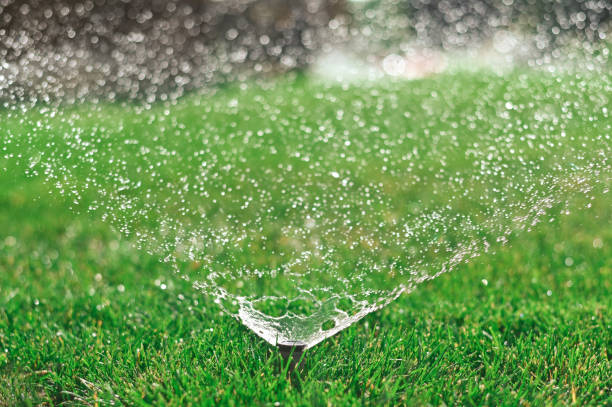
Walk your lawn during an irrigation cycle and you'll see them at work: some heads shooting single rotating streams across big stretches of turf, others misting steady fans over narrow strips, maybe tubing seeping quietly in the flower beds. Most homeowners have three or four different watering technologies running in their yard — and couldn't name one of them.
That matters more than it sounds. Each sprinkler head type covers differently, fails differently, and needs different maintenance — and a huge share of common lawn problems (the dry crescent, the soggy strip, the bed that never thrives) trace back to the wrong head in the wrong place, or the right head quietly failing. Here's the field guide to what's in your yard: how to identify each head type, what it's for, and what each one needs to keep doing its job.
How to spot them: Rotors are the heads that shoot a single stream (or a few fingers) of water that sweeps back and forth across the lawn in a slow arc. They're your yard's distance throwers, covering large turf areas — often 15 to 40+ feet — from each head.
Where they belong: Big open lawn areas — front yards, back yards, anywhere broad turf coverage is needed with fewer heads.
Their personality: Rotors apply water slowly — a deliberate, low-precipitation delivery that soil (especially clay) can absorb without runoff. That's a feature, but it means rotor zones need longer run times than spray zones to deliver the same depth of water. One of the most common controller mistakes is running rotor and spray zones for identical durations — underwatering the rotors, drowning the sprays, or both.
How they fail:
What they need: Seasonal observation of the full rotation — every rotor watched through a complete sweep — plus arc and distance readjustment as landscapes change and heads settle.
How to spot them: Fixed spray heads pop up and throw a constant fan of fine mist — no movement, no sweeping — covering a set pattern (quarter-circle, half, full) over short distances, typically 5 to 15 feet.
Where they belong: Smaller and narrower turf areas — side yards, parkway strips, tight corners, and shapes rotors would overshoot.
Their personality: The opposite of rotors: sprays deliver water fast — high precipitation in short bursts. That's efficient for their scale but makes them the number-one runoff culprit on clay soil and slopes, where the ground can't drink as fast as sprays pour. Spray zones want short run times, often benefiting from cycle-and-soak splitting.
How they fail:
What they need: Regular nozzle cleaning/inspection, realignment after every season of mower encounters, and trimming clearance around each head.
How to spot it: No pop-ups, no spray — tubing running through flower beds and around shrubs, releasing water slowly through emitters directly at the soil, often invisible under mulch. If your beds get watered but you never see it happen, you've got drip.
Where it belongs: Landscape beds, shrubs, trees, and gardens — anywhere targeted root-zone watering beats broadcast spray. Drip puts water precisely where ornamentals drink, keeps foliage dry (a real disease-prevention benefit), and doesn't water the open mulch between plants — which is also weed suppression, since broadcast-sprayed beds irrigate their weeds generously.
Its personality: Extremely efficient and extremely quiet about failing. Drip's greatest strength — invisibility — is its maintenance weakness: a clogged emitter or chewed line produces no geyser, no puddle, no drama. Just a shrub that mysteriously declines over three summer weeks, discovered only when it's expensive.
How it fails: Clogged emitters (fine passages + hard water), cut or chewed tubing (shovels, critters), fittings popped loose under mulch, and pressure problems starving the far end of long runs.
What it needs: Periodic deliberate inspection — running the zone and physically checking that emitters emit, especially at run-ends and around your most valuable plants. Drip is the zone where "it's probably fine" costs mature landscaping.
Here's the design principle that explains a whole category of mystery lawn problems: rotors, sprays, and drip apply water at wildly different rates — so mixing them on one zone makes correct watering impossible. A zone with both rotors and sprays running the same minutes will always overwater the spray areas or underwater the rotor areas; there is no run time that satisfies both. If your yard has a chronically soggy patch neighboring a chronically dry one on the same zone, mixed heads are a prime suspect — and rezoning or head-matching is the actual fix that no controller adjustment can substitute for.
Put the field guide together and a well-designed yard reads like this: rotors sweeping the open lawn on long, slow run times; sprays fanning the narrow strips in short bursts; drip seeping through the beds on its own quiet schedule — each zone timed to its head type's delivery rate, each head type getting its own maintenance attention. That's also exactly what a professional irrigation inspection walks through: every zone run live, every rotor's arc watched, every spray's alignment checked, drip verified emitter by emitter, and run times matched to what each head type actually delivers. It's a different level of care than "the sprinklers turn on" — and it's the difference between a system that waters and a system that waters right.

When did someone last actually watch every head in your yard do its job? Kangaroo Outdoor Solutions provides complete irrigation maintenance — zone-by-zone inspections, repairs, realignment, and run-time tuning for every head type on your property. Build your quote today and get a system that earns its water bill.