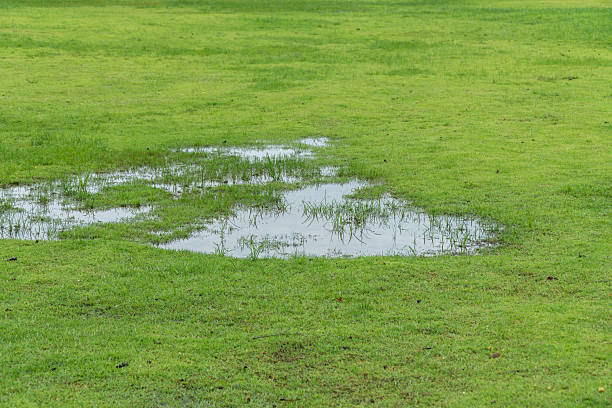
Some lawn problems announce themselves politely. Standing water isn't one of them: the squishy zone that never dries, the puddle that outlives every rain by three days, the corner where the mower leaves ruts and the grass has quietly given up. Soggy spots are ugly, they breed mosquitoes and fungus, they kill the turf beneath them — and near a foundation, they can graduate from lawn problem to house problem.
But here's what matters most: standing water is a symptom with at least four completely different causes, and each one has a different fix. Homeowners who guess wrong spend money on the wrong solution while the real cause keeps pumping water into the same spot. So before anything gets dug, drained, or regraded — diagnose. Here's how.
Every soggy spot is fed by one of two sources — water arriving faster than the ground can shed it (rain and runoff meeting bad grading or drainage), or water being delivered continuously (your own irrigation system leaking or overapplying). And in clay-soil country, a third factor amplifies both: ground that can't absorb what lands on it. The clues sort them out fast:
A zone that's soggy during a rainless week — while the rest of the lawn dries normally — is being fed. That points hard at irrigation: a leaking underground line, a weeping valve that never fully closes, or a broken head dumping its zone's water in one place. Supporting evidence: a suspiciously lush green patch around the wet zone (constant water plus the nutrients it carries), a water bill trending up, or sogginess that maps to one sprinkler zone's territory. The test: run each zone and watch — and note whether the wet spot's moisture cycle tracks your watering days. The fix: irrigation repair — find and fix the leak, valve, or head. This is the cheapest fix on the list and the one that stops an ongoing water bill hemorrhage, which is why it's checked first, always
If rain and irrigation sheet across the lawn and pool in every low wrinkle — but eventually drain — the problem isn't a leak or a hole in the yard. It's soil that won't drink: compacted clay behaving like pavement. Supporting evidence: the screwdriver test failing (won't push into soil), thin struggling turf across the compacted zones, runoff streaming to the curb during every watering. The fix: core aeration — opening thousands of channels so water infiltrates instead of traveling — plus cycle-and-soak watering that matches clay's slow absorption rate. This is the most common "drainage problem" in clay country, and it's fixed on the lawn's surface, not with buried pipe
Water obeys grade. If the yard has genuine low pockets — settled trenches over old utility lines, depressions from removed trees, or simply a lot graded with dips — rain collects there by law of physics and leaves only by slow soak or evaporation. Supporting evidence: puddles in identical locations every time, visible dips you can see standing at the fence line. The fix depends on scale: shallow depressions can be topdressed — filled gradually with soil in thin layers the turf grows through (never buried in one deep dump) — while bigger grading issues need real regrading work
Sometimes the yard is innocent and the water is imported: downspouts dumping roof water right at the foundation or into a bed, a neighboring lot draining across yours, or a slope delivering every storm to your low side. Supporting evidence: sogginess radiating from downspout exits, wet lines tracing the flow path after rain. The fixes: downspout extensions or buried drain lines carrying roof water away from the house; and for genuine through-yard flow, the classic drainage toolkit — French drains (gravel-and-pipe trenches that intercept and redirect subsurface water) and dry creek beds or swales (graded channels that move surface flow deliberately, and can look like landscaping while doing it)
The standing-water problem compounds on every front while it waits:
Pulling the diagnostics into a sequence:
The order matters because the early steps are cheaper, more commonly the answer, and sometimes make the later steps unnecessary — plenty of "we need a French drain" yards actually needed a valve repair and two seasons of aeration.
Once the water source is solved, the recovery is standard turf work: drowned zones raked out and re-established, the nutsedge and fungus pressure treated as the soil normalizes, and the area folded back into the regular maintenance rhythm. The spot that was a rut-scarred mosquito farm becomes ordinary lawn again — which is the quiet satisfaction of drainage work done in the right order: not a heroic construction project, but a correct diagnosis followed by the fix that matched it.

Got a spot that never dries? Kangaroo Outdoor Solutions can diagnose it — irrigation inspection, aeration for compacted clay, and the maintenance that brings drowned turf back. Build your quote today and turn the swamp back into lawn.