Every irrigation system is a machine with dozens of moving parts, buried underground, operating before dawn — and like every machine, it breaks in predictable ways. Ask any irrigation technician what fills their schedule and you'll hear the same short list, over and over. Knowing that list is genuinely useful for a homeowner: each common repair announces itself with specific symptoms, and recognizing them early is the difference between a quick fix and a dead zone of turf.
Here are the seven most common irrigation repairs — what fails, what it looks like from your side of the lawn, and what the fix involves.
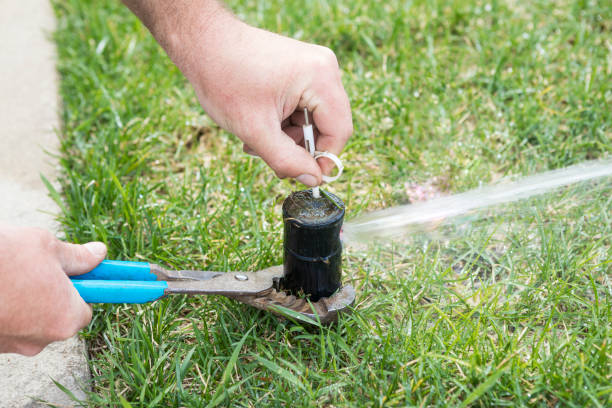
The champion of repair calls. Heads live at grass level, where mower decks, car tires, and feet find them. A cracked body or snapped riser turns the head into a low geyser — bubbling or gushing at ground level while the rest of the zone weakens (all that pressure escaping one hole).
What you'll see: A wet, eroded crater around one head; the surrounding zone's spray noticeably weaker; sometimes a literal fountain during the pre-dawn run you finally witness by accident.
The fix: Head replacement — fast, inexpensive, and one of the highest-payoff repairs there is, since a single broken head can waste enormous water while browning its neighbors.
Dirt, mineral scale, and debris find the fine orifices of spray nozzles; time wears their spray patterns ragged.
What you'll see: Sputtering, uneven fans; a spray with visible gaps or "fingers"; a dry crescent in the turf shaped exactly like the missing part of a pattern.
The fix: Nozzle cleaning or replacement — trivial in cost, and the reason a zone-by-zone inspection walks past every single head watching it work.
Nothing broken — just aimed wrong. Heads shift with soil settling, mower bumps, and traffic until they're watering the fence, the driveway, or the street with dedication.
What you'll see: Wet pavement after every cycle; a dry strip in the lawn beside a hard surface; the classic head watering the sidewalk at a perfect right angle to where it should point.
The fix: Realignment and arc adjustment — minutes of work, and collectively one of the biggest water-waste corrections on most systems.
Pop-up heads are supposed to rise, spray, and retract. Wear, debris, and soil buildup defeat both halves: heads that won't rise water a little circle around themselves; heads that won't retract get scalped by the next mow.
What you'll see: A dry zone with one suspiciously green ring; a head standing at attention days after watering (a mower casualty in waiting); heads swallowed below grade by accumulated soil and thatch, spraying underground.
The fix: Cleaning, riser repair, or raising the head back to grade.
Valves are the system's switches — and when one sticks open, its zone weeps or runs continuously; when one fails closed (or its solenoid dies), the zone goes silent entirely.
What you'll see: Stuck open: a chronically soggy zone, moss and nutsedge moving in, mysterious water bills, sometimes audible hissing at the valve box. Failed closed: an entire zone of browning turf while the rest of the lawn thrives — the "one dead stripe" pattern.
The fix: Valve rebuild or replacement, solenoid swaps, and the diagnostic work of finding which buried box holds the culprit — squarely professional territory, and one of the most consequential repairs on the list because stuck-open valves waste water around the clock.
Shovels, aerators without flags, tree roots, and time all find buried lines. Lateral line leaks soak one area during zone runs; main line leaks — pressurized around the clock — leak always.
What you'll see: A soggy spot that never dries (main line) or that recharges every watering day (lateral); a depression forming as leaking water erodes soil; pressure loss across a whole zone; the water bill telling a story the lawn confirms.
The fix: Locating the leak (the skilled part) and repairing the line — with urgency scaled to which line it is, since main-line leaks bill you every hour of every day.
Bed drip lines suffer quietly: emitters clog with scale, tubing gets cut by trowels and chewed by critters, fittings pop loose under mulch — and none of it geysers or puddles. It just stops delivering.
What you'll see: Usually nothing until the plants report — a shrub declining, seasonal color failing in one stretch of bed, the far end of a drip run drying out. Drip failures are discovered by their casualties.
The fix: Line repair, emitter replacement, and — the real solution — periodic deliberate drip inspection, because the invisible zone is the one that most needs scheduled eyes.
Read the list back and notice what's true of all seven: every repair is small, and every symptom is expensive to ignore. Heads, nozzles, and alignment cost little to fix and a season of browned turf or wasted water to neglect; valves and lines cost more attention and punish delay proportionally. Which is the entire argument for routine irrigation maintenance: a scheduled zone-by-zone inspection catches every item on this list in its cheap phase — before the dry patch, before the fungus zone, before the bill. Your system is going to generate these repairs either way. The only variable is whether they're found by a technician or by your lawn.

When did someone last watch every zone on your system actually run? Kangaroo Outdoor Solutions provides complete irrigation maintenance and repairs — inspections, head and valve work, leak repair, and drip care, all season long. Build your quote today and catch the small stuff while it's small.