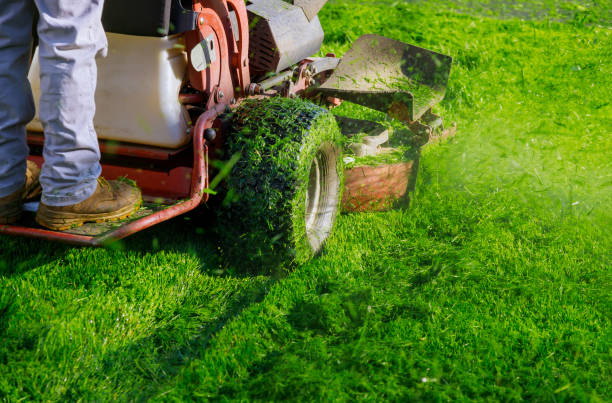
Ask a homeowner who handles their yard and you'll often get a list: a mowing service, a separate company for the sprinkler repairs, someone's cousin for the shrub trimming, a landscaper they call for mulch, and the weed treatments handled by whoever's flyer showed up. Five providers, five schedules, five phone numbers — and one yard that somehow still has problems falling through the cracks between them.
The alternative model is one team handling the entire property, and its advantages go well past convenience. Here's what actually changes when the whole yard belongs to a single company — the coordination, the accountability, and the crack-proofing that no collection of separate vendors can match.
The multi-vendor model has a structural flaw: every provider owns their piece, and nobody owns the whole. The mowing crew notices the sprinkler head geysering — but irrigation isn't their job, so they mow around it and move on. The treatment company's fertilization underperforms all season because a zone quietly failed — but they don't touch sprinklers, so the mystery persists. The trimming crew works around beds the weed guy hasn't visited; the mulch gets installed the week before the bed treatment that should have preceded it.
None of these are anyone's fault, exactly — each vendor did their scope. That's the problem: yards don't have problems in scopes. They have problems in the seams — and the multi-vendor model is all seams. When one team owns the entire property, the seams disappear: the crew that spots the sprinkler issue works for the company that fixes it, the treatment schedule knows the irrigation status, and everything discovered by anyone lands with the party responsible for everything.
The second change is coordination — because yard services aren't independent tasks; they're a system with an order. Aeration timed beside fertilization multiplies both. Pre-emergent and aeration need sequencing in their shared seasons. Bed prep precedes mulch, which pairs with the monthly bed treatments. Leaf removal threads through the fall feeding calendar; the mowing rhythm adjusts around treatments and season.
One team runs that whole calendar as a single plan — each service placed where it helps the next, automatically. Five vendors run five calendars that meet only by luck. The difference isn't cosmetic: sequencing is a real multiplier on results, and it's structurally unavailable to the scattered model no matter how good each individual vendor is.
Then there's the moment something goes wrong — a brown patch spreading, a bed declining, a corner of the yard that just looks off. Multi-vendor homeowners know exactly how this goes: the mowing company says it's a watering issue, the sprinkler company says the coverage is fine and it's probably fungus, the treatment company says their applications were correct — and the homeowner becomes the case manager, coordinating diagnoses among parties who each have a reason it isn't theirs.
With one team, there's nowhere for a problem to be someone else's. The company that mows, waters, feeds, and trims the property owns whatever the property does — the diagnosis happens inside one organization with full information, and the fix is theirs regardless of which service area it touches. That single change — one accountable party — is what most homeowners end up valuing above every other benefit, because it converts the yard from a committee project into a handled thing.
The everyday benefits stack on top. One point of contact for everything, instead of five threads. One coordinated schedule, communicated, instead of five arrival windows. One crew ecosystem that knows the property deeply — the gates, the dog, the quirks — across every service it receives, with the same-team familiarity compounding in every category at once. And one plan that can flex — services added, adjusted, or scaled seasonally within a single relationship, instead of renegotiating a vendor patchwork every time the property's needs change.
There's a quality floor built in, too: a company answerable for the whole yard's outcome has no incentive to do any piece badly, because it can't hand the consequences to the next vendor. The whole property is the reputation.
One team handling the entire yard isn't a bundling discount pitch — it's a structurally better model: no seams for problems to fall through, services sequenced into a system, one accountable party, and a property that gets managed instead of merely serviced in pieces. The homeowners who make the switch describe the same before-and-after: the yard didn't just get better — it got quieter. Fewer calls, fewer mysteries, fewer things to track. Just a property that's handled, by people who own all of it.

Give your whole yard one home. Kangaroo Outdoor Solutions handles everything — lawn maintenance, turf control, irrigation, trimming, beds, mulch, and leaf season — on one coordinated plan with one accountable team. Build your quote today and close the seams for good.