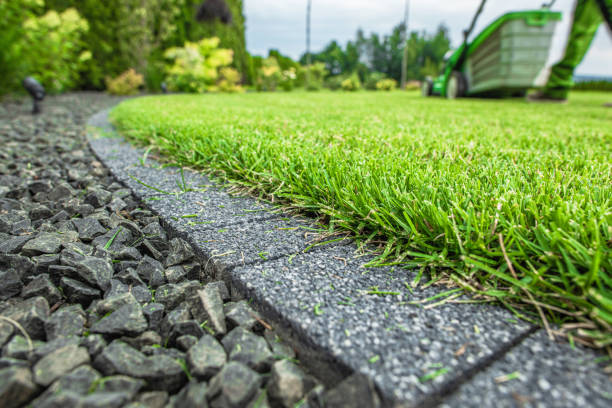
Here's an experiment you can run on your next neighborhood walk: find the yards that make you think "that place is dialed in" — and look closely at what's actually creating the impression. It's usually not exotic landscaping or a flawless lawn. It's the lines. Razor-straight turf edges along the driveway. A clean vertical face where grass meets sidewalk. Bed borders cut so sharply the mulch looks framed.
Edging is the most underrated detail in all of property care — cheap, fast, and responsible for a wildly outsized share of how "maintained" a property reads. It's also the detail most often skipped, faked, or done wrong. Here's why edges matter so much, the difference between edging and trimming (they are not the same thing), how the crisp look is actually achieved, and what quietly happens to properties that let their lines go.
Human eyes are line-detectors. We read landscapes the way we read rooms — and boundaries are what tell us whether a space is composed or chaotic. A lawn with crisp edges reads as intentional: someone defined where grass ends and everything else begins, and is actively enforcing it. A lawn with fuzzy, creeping edges reads as drifting — even if the turf itself is healthy and green.
This is why edging punches so far above its cost:
Homeowners use the words interchangeably; the results are completely different, and knowing the difference lets you evaluate any crew's work at a glance:
String trimming cuts grass horizontally — same plane as the mower — in places the mower can't reach: fence lines, posts, tree rings, tight corners. Done right, trimmed areas match the mow height seamlessly. Trimming maintains the lawn's surface.
True edging cuts vertically — slicing straight down at the boundary where turf meets hard surface, creating a clean two-to-three-inch mini-trench with a crisp vertical face of soil. This severs the creeping runners (Bermuda's specialty) that constantly try to crawl over the concrete, and produces that sharp shadow-line that reads as "detailed" from the street.
The common shortcut — tilting a string trimmer sideways to burn a rough line along the sidewalk — is trimming cosplaying as edging. It scalps a ragged, wavering strip, browns the border grass, and lasts days. A true edge, cut with a dedicated blade edger (or a properly practiced vertical technique), is straight, clean, and durable. If your "edged" borders look chewed and brown, you now know what you're actually getting.
What the crisp look requires, surface by surface:
A blade edger runs the boundary line, cutting a clean vertical face and throwing the severed runners and soil crumbs onto the pavement — which is why edging happens before the final blow-off, so the debris leaves with everything else. Maintained weekly-to-biweekly in growing season, each pass is quick because the line never gets far from perfect. Restored from neglect, the first cut is the hard one — re-establishing the line through inches of creeping overgrowth — and every pass after is maintenance.
Bed lines are cut as a shallow trench edge — a defined mini-moat separating lawn from bed — either maintained by machine or hand-cut with an edging spade for the deepest definition. This line is doing real work beyond looks: it's the first defense against lawn-grass invasion of your beds, forcing Bermuda runners to visibly cross open trench where they can be caught, instead of slipping invisibly from turf into mulch. A sharp bed edge plus full-depth mulch is the bed-protection combo.
Edges, then trim, then blow: every severed blade and soil crumb off the hard surfaces, so the final look is lines and clean planes. The visit isn't done until the property reads finished from the street.
Skipping edging isn't a static choice — it's a progression:
That restoration cost is the quiet argument for consistency: edges maintained weekly cost minutes; edges restored yearly cost hours. Like most of lawn care, the cheap version is the rhythm, not the rescue.
Here's the real reason edges deserve this many words: they're a signal. A crew that edges every visit — true vertical edges, beds included, debris blown clean — is a crew running a complete standard, because edging is precisely the step that gets dropped when a service cuts corners. The edge is where "mowed" becomes "maintained." Check any property's lines and you'll know, in five seconds, everything about the care it's getting.

Get the lines that make the whole property read sharp. Kangaroo Outdoor Solutions includes true edging, trimming, and full blow-off in every lawn maintenance visit — crisp borders, framed beds, finished streetside look, week after week. Build your quote today and see what a real edge does for your curb appeal.