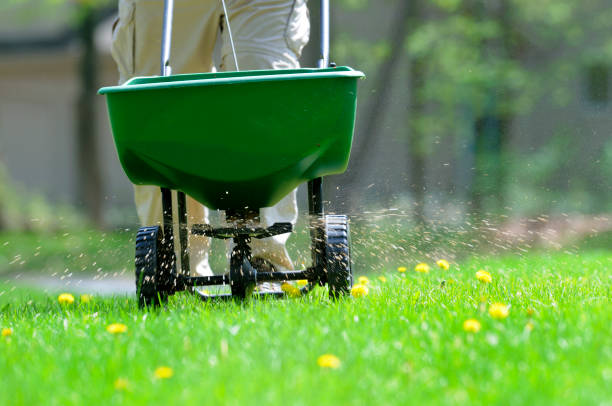
It's the most seductive product in the garden center: one bag, two jobs. "Weed and Feed" promises to fertilize your lawn and kill your weeds in a single Saturday pass with the spreader — which is exactly why millions of bags sell every spring, and exactly why so many lawns end up confused about why the weeds are still there and the grass looks worse.
This isn't a hit piece on DIY lawn care. It's an honest look at what combination weed-and-feed products actually are, the built-in compromise at the heart of every bag, the specific situations where they cause real damage — and what a professional turf program does differently that explains the results gap you see between program lawns and bag lawns on the same street.
Here's the fundamental issue hiding inside every weed-and-feed bag, and once you see it, you can't unsee it: fertilizing and weed control have different optimal timing — and one bag forces them onto the same day.
Think about what each job actually requires:
Those windows don't overlap. So a weed-and-feed applied early enough for the pre-emergent to matter is feeding a dormant lawn (wasting the fertilizer and nourishing winter weeds instead), while a bag applied late enough for the feeding to count has missed the pre-emergent window entirely — spreading prevention product onto weeds that already exist. Every weed-and-feed application is mistimed for at least one of its two jobs. The bag doesn't fail because you used it wrong; it fails because the concept requires a compromise the biology doesn't allow.
The post-emergent versions (the bags that kill existing weeds while feeding) carry a different mismatch: granular herbicide has to physically stick to weed leaves to work — which is why the labels ask for applications on dew-wet grass — and coverage is hit-or-miss compared to targeted liquid treatment. Meanwhile, the herbicide lands everywhere, including all the turf that has no weeds, which brings us to the next problem.
Flip a weed-and-feed bag over and read the small print, and you'll find the section most buyers never see: the grass types the product will damage. Several common weed-and-feed active ingredients that Bermuda tolerates will injure St. Augustine — and the damage shows up as exactly the yellowing, thinning stress the homeowner then tries to fix with... more product.
This is where the DIY risk gets real: a huge share of homeowners don't know their grass type with certainty, and the bag can't check. A professional program starts with that identification and selects every product accordingly — the unglamorous expertise that prevents the most expensive category of DIY mistake: paying to damage your own lawn.
Add the application-rate problem — broadcast spreaders miscalibrated, overlapping passes double-dosing strips of lawn (those mystery stripes of burned or extra-green turf), edges over-thrown into beds where herbicide granules meet ornamental roots — and the one-bag Saturday carries more ways to go wrong than the marketing suggests.
The results gap between program lawns and bag lawns isn't about secret products. It's about unbundling the jobs and running each on its own correct calendar:
Six to eight visits, each doing one job at its right time, versus one or two Saturdays doing two jobs at a compromised time. That's the entire explanation of the results gap — no magic, just calendar integrity.
The bag looks cheaper, and per-application it is. But run the real math: a serious DIY year needs separate pre-emergent (twice or three times), seasonal fertilizers (several bags of different formulations), post-emergent products for the breakthrough weeds — plus the spreader, the sprayer, and your Saturdays. Priced honestly against a professional program's annual cost, the gap narrows dramatically — and that's before counting the expensive failure modes: the missed pre-emergent window that buys a summer of crabgrass, or the wrong-product burn that buys a resod. The bag's true price includes the outcomes.
Fairness requires saying it: a knowledgeable homeowner who knows their grass, tracks soil temperatures, buys separate single-purpose products, and hits every window can absolutely run a good DIY program — the biology doesn't care who applies it correctly. The weed-and-feed bag is the problem, not the homeowner; it's a shortcut through a process that punishes shortcuts. If you're going DIY, go unbundled. And if tracking six application windows across a year sounds like a part-time job — that's because it is one, and it's precisely the job a turf program exists to take off your plate.

Skip the compromise in the bag. Kangaroo Outdoor Solutions' Turf Control Program runs every feeding and weed treatment at its right time, with the right product for your grass — all year, automatically. Build your quote today and see what correct timing does for a lawn.