There's a service in lawn care that consistently produces bigger results than fertilizer, works longer than any treatment, and gets skipped by most homeowners because its entire benefit happens where nobody can see it. That service is core aeration — and if your lawn has ever struggled despite decent watering and regular mowing, there's a strong chance the explanation is sitting in the soil that aeration exists to fix.
This is the plain-language guide to core aeration: what it actually does underground, why North Texas lawns need it more than lawns almost anywhere else, and what changes above ground when the work below gets done.
Every lawn lives or dies by what happens in its top few inches of soil. Roots need three things from that zone: water getting in, oxygen moving through, and physical space to grow. Compacted soil denies all three at once.
And soil compacts constantly. Foot traffic, mower passes, pets, kids, rain impact, and simple settling all press soil particles tighter over time — and in North Texas, the problem is supercharged by what's under our lawns: dense clay, made of particles so fine they pack together with almost no space between them. Clay soil under normal residential use gradually approaches something closer to pavement than to garden soil.
The consequences show up everywhere a homeowner looks, usually without the cause ever being named. Water from sprinklers and rain sheets off instead of soaking in — the lawn gets watered constantly and stays thirsty, because the moisture never reaches the roots. Roots stay shallow by force, trapped in the top inch or two of workable ground, which is exactly the layer that bakes dry fastest in summer — so the lawn collapses in the first real heat wave while deeper-rooted lawns ride through. Fertilizer sits on the sealed surface instead of reaching the root zone, quietly cutting the value of every feeding. And the turf thins in the traffic areas first, then generally, with weeds claiming the openings.
If any of that describes your lawn, run the two tests that settle it. Push a screwdriver into the soil — if it takes real force or stops an inch down, your roots face that same wall every day. And watch a sprinkler zone run — if water pools or streams toward the curb within minutes, your soil has stopped absorbing.
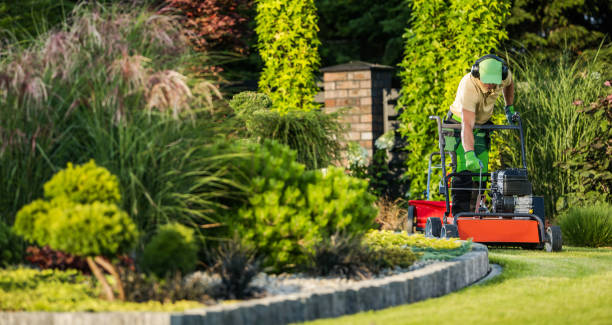
Core aeration attacks compaction directly and mechanically. A machine with hollow steel tines rolls across the lawn, punching several inches deep and pulling out thousands of small plugs of soil — leaving the lawn dotted with open holes and scattered cores.
The word core matters. True core aeration removes soil, creating real space the surrounding ground can relax into. The imitation — spike aeration, done with solid spikes or roller attachments — just pokes holes while compressing the soil around them tighter, accomplishing close to the opposite. The test is simple: if there are no plugs on the lawn afterward, it wasn't core aeration.
Those thousands of holes transform how the lawn functions, starting immediately. Water infiltrates instead of running off — the very first irrigation cycle after aeration delivers visibly more moisture into the ground. Oxygen reaches the root zone, which roots literally require to grow. Roots gain open channels to expand downward — the deep-rooting behavior that builds drought tolerance. Fertilizer applied after aeration drops straight through the openings to the roots, which is why aeration paired with feeding is the highest-leverage combination in lawn care. And the plugs left on the surface break down over a week or two, returning their soil and nutrients while inoculating the thatch layer with the microbes that decompose it.
Aeration works best when the grass is actively growing and can quickly fill the opened soil with new roots — which for warm-season lawns means two windows, each doing a different job.
Spring aeration is summer preparation. Opening the soil as the lawn enters its strongest growth phase means the whole spring gets spent building roots downward into the loosened ground — and those deep roots are exactly what carries a lawn through July and August. Spring rains soak in and bank as soil moisture instead of running off, and the spring feeding lands in an open root zone.
Fall aeration is recovery and setup. By September the soil carries a full summer of accumulated compaction — its worst condition of the year — right as the lawn enters its critical rebuilding season. Fall aeration relieves that damage, opens the door for the fall fertilization that banks next spring's energy reserves, and lets a whole winter of rain recharge the soil deep.
On clay soil under real use, the twice-yearly rhythm is the standard that wins — clay re-compacts continuously, and the six-month cycle keeps the ground open year-round instead of rescued annually.
The payoff arrives on a lawn timeline. Within days, the water behavior changes — irrigation soaking in, runoff shrinking. Within weeks, the lawn responds to everything working better: feeding that reaches roots, moisture that penetrates, color deepening. Across the first season, density builds as roots expand into the opened ground, and the summer stress test tells the real story — the aerated lawn holding green through heat that browns its compacted neighbors. And year over year, the rhythm compounds: soil structure genuinely improving, the lawn thickening, every other service and dollar working at higher efficiency because the ground finally lets them through.
Core aeration is the least glamorous service on the maintenance calendar and the one doing the most fundamental work. Everything your lawn receives — water, fertilizer, rain, effort — arrives at the top of the soil. Aeration is what decides how much of it ever gets in.

Open your soil and watch everything else work better. Kangaroo Outdoor Solutions provides professional spring and fall core aeration — deep hollow-tine cores, irrigation flagged, perfectly timed with your lawn's feeding schedule. Build your quote today and fix your lawn from the ground down.