Some lawn services are simply better in combination — and no pairing in all of lawn care outperforms core aeration followed by fertilization. Each service is valuable on its own. Together, they multiply each other in a way that's visible in the turf within weeks — which is why professionals schedule them as a package by default, and why the best lawns on any street are almost always lawns where the two happen side by side, spring and fall.
If you've ever wondered whether the pairing is a real synergy or just a convenient upsell, this is the full explanation: what each service does alone, exactly why they amplify each other, and how the combination fits the North Texas calendar.
Fertilization has one job: deliver nutrients to the root zone, where the grass can absorb them and convert them into growth, density, and color. Everything about a feeding's value depends on that delivery — and delivery is precisely where compacted soil sabotages it.
North Texas clay under normal residential use gradually seals itself: particles pressed tight by traffic, mowing, rain, and settling until water and everything dissolved in it struggle to penetrate. Apply fertilizer to that surface and a frustrating share of it never reaches the roots — some sits in the thatch and surface layer feeding nothing, some washes off with the runoff that sealed clay produces every watering, and what does penetrate feeds a root system that compaction has trapped in the top inch or two of soil anyway.
The homeowner sees the result without seeing the cause: feedings that underperform, color that improves less than expected, a lawn that seems immune to effort. The fertilizer wasn't wrong. The ground wouldn't let it in.
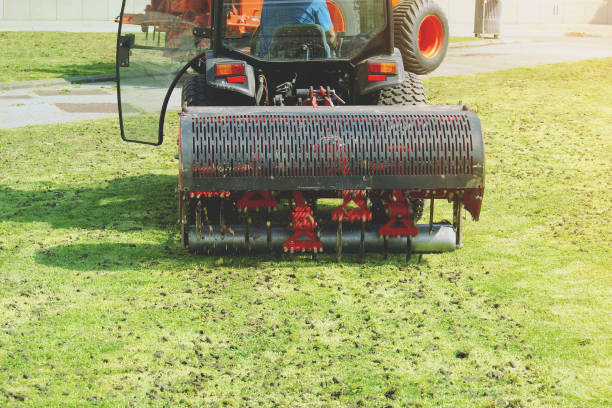
Core aeration solves the delivery problem directly — thousands of extracted soil plugs opening channels through the sealed surface, letting water, oxygen, and nutrients pour into the root zone while giving roots physical corridors to expand downward. It's the most fundamental soil correction in lawn care.
But aeration by itself opens the door without sending anything through it. The freshly aerated lawn is primed — soil breathing, channels open, roots ready to grow into the loosened ground — and root growth runs on nutrition. An aerated lawn with nothing to eat recovers and improves on whatever the soil already held; an aerated lawn that gets fed at that exact moment exploits the opening at full capacity. The channels are temporary, too — the holes gradually close as plugs break down and soil settles over the following weeks — so the window when the soil is most open is a window worth using.
Put the two services together in sequence — aerate, then fertilize — and each one's limitation becomes the other's setup:
The aeration solves fertilization's delivery problem. Nutrients applied over fresh aeration holes drop directly into the root zone through thousands of open channels instead of sitting on a sealed surface. The same bag of fertilizer delivers dramatically more of itself to the roots — the feeding suddenly performs the way the label always promised.
The fertilization solves aeration's fuel problem. The roots poised to expand into the opened soil get the nutrition to actually do it — driving deeper and denser through the loosened ground during the very weeks the channels are most open. The aeration's structural benefit converts into living root mass at maximum speed.
And the timing compounds both. The pairing lands in the growing season by design — spring or fall, when the grass is active — so the opened soil, the delivered nutrients, and the plant's own growth engine all peak together. Water joins the multiplication too: irrigation and rain in the weeks after the combo soak deep through the channels, carrying the nutrients down and keeping the expanding roots supplied.
The result is more than the sum: a feeding that might have produced modest improvement on sealed soil, and an aeration that might have produced gradual improvement unfed, together produce the visible response — deeper color, thickening density, a lawn that looks like something changed — because something did, above and below at once.
The combination runs naturally in both of aeration's seasonal windows, doing a different job in each.
In spring, the pairing is summer preparation: soil opened as the lawn enters its strongest growth phase, spring feeding delivered straight to the root zone, and the whole season ahead for roots to drive deep on that fuel — building the drought equipment the lawn will survive on in July and August.
In fall, the pairing is the year's highest-leverage move: aeration relieving a full summer's accumulated compaction right as the lawn enters its recovery season, and the fall fertilization — the most important feeding of the year, the one that rebuilds summer thinning and banks the reserves powering next spring's green-up — delivered through open channels into the root zone where the banking happens. Fall aeration plus fall feeding is, plainly, the single best afternoon a North Texas lawn gets all year.
One scheduling note that argues for professional coordination: pre-emergent weed control shares these seasons, and aeration and pre-emergent need sensible sequencing so the soil-surface barrier and the soil-opening service each do their jobs. It's a routine coordination when one company runs the whole calendar — and one more small reason the aeration-fertilization pairing performs best inside a program rather than as isolated purchases.
Core aeration opens the soil; fertilization fills it. Either alone is a good service half-realized. Together, timed to the growing season, they're the highest-return combination in lawn care — the reason the twice-yearly aeration lawns with feeding programs pull visibly ahead of their streets, season after season. If your lawn gets one upgrade this year, make it the pair.

Get the combination working for your lawn. Kangaroo Outdoor Solutions pairs spring and fall core aeration with perfectly timed fertilization — open soil, delivered nutrition, and results you can see. Build your quote today and schedule the best afternoon your lawn gets all year.