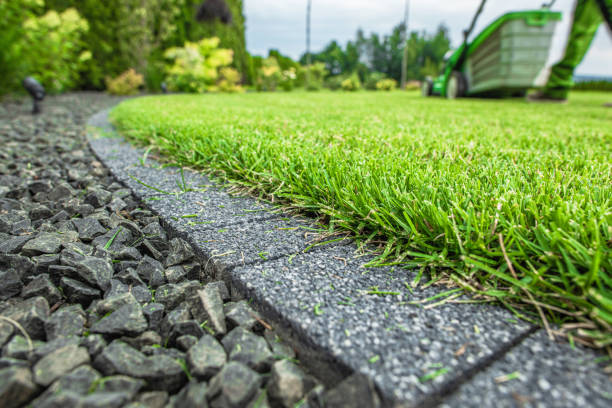
Here's an experiment worth running the next time you drive through your neighborhood: find the lawns that look genuinely sharp — the ones that read professionally maintained from the street — and figure out what they have in common. It usually isn't the greenest grass or the biggest landscaping budget. It's the lines. Crisp, clean, defined edges along every driveway, sidewalk, and bed — and the moment you notice it, you can't unsee it: edging is the detail doing a disproportionate share of the work in every good-looking lawn you've ever admired.
Here's why that small strip of definition matters so much, what proper edging actually involves, and why it's the clearest single marker separating complete lawn maintenance from a mow-and-go.
The psychology of curb appeal is mostly about edges. When someone looks at a property, their eye doesn't inventory the turf blade by blade — it traces the boundaries: where lawn meets driveway, where grass meets sidewalk, where turf meets bed. Sharp boundaries tell the brain deliberate, maintained, cared for. Blurred boundaries — grass creeping over the pavement in soft tongues, bed lines dissolved into ambiguity — tell it unkempt, even when the grass itself is healthy and freshly cut.
That's why a modest lawn with excellent edges consistently outlooks a lush lawn with none: the lines are the frame, and the frame sets the verdict. It's also why edging delivers the best visual return per minute of any task in lawn care — a few minutes of definition upgrading the read of the entire property.
Real edging is a specific cut, made with a specific tool, and it's worth knowing the difference because the shortcuts are everywhere.
A true edge is a clean vertical cut where turf meets hard surface — made with a blade edger that slices straight down at the pavement line, creating a small defined channel that separates grass from concrete. The result is a sharp, architectural line: turf standing at attention on one side, clean pavement on the other, a crisp shadow gap between. Because the cut is vertical, it stops the runners cleanly and holds its definition between visits — maintained weekly, the line stays essentially permanent.
The common impostor is the tilted string trimmer — spun sideways to burn a line along the pavement. It's faster, and it shows: a ragged, scalped, browning strip instead of a clean vertical face, rough within days and hard on the turf at the boundary. The third state is no edging at all, and every lawn displays its version: Bermuda's runners advancing over the pavement edge, building those rounded tongues of turf that eventually carry soil with them onto the concrete — the creep that makes even a mowed lawn read fuzzy.
The quick diagnostic for any lawn service, including your own: look at the driveway line a few days after a visit. Vertical and crisp — real edging. Brown and ragged — trimmer cosplay. Soft and green over the concrete — skipped entirely.
Edging isn't only about pavement. The line where lawn meets flowerbed — the cut trench that defines the bed's border — does the same framing work for the landscape's most visible features. A clean bed edge makes the mulch read intentional, the plantings read designed, and the lawn read contained; a dissolved one lets the two zones bleed together until neither looks maintained.
The bed edge is also functional defense: that cut trench is the first line against Bermuda's constant invasion of the beds — the visible moat that runners must cross, where they can be caught before they thread into the mulch and plantings. Edging the beds is weed control wearing an aesthetics costume, and it's one of the quiet ways the mowing service and the bed care service reinforce each other.
Here's the economics that makes edging a rhythm service rather than a project: maintained weekly, edges take minutes — the blade re-tracing an established line, removing a week of encroachment, done. Neglected for a season, the same edges become restoration work: the overgrown lip of turf and accumulated soil that has to be cut back, lifted, and re-established — an afternoon of labor to recover what minutes a week would have kept.
That asymmetry is the whole argument for edging as part of every maintenance visit rather than an occasional add-on. It's also why edges are such a reliable tell about a service's overall standard: a company that maintains true edges every week is running the complete-visit model — mow, edge, trim, blow — and a company that skips them is selling you the mow alone, whatever the invoice says. The lines don't lie.
The takeaway for your own property: if the lawn looks fine but never quite sharp, the grass probably isn't the problem. Look at the lines. Crisp edges are the cheapest transformation in lawn care — and on a weekly rhythm, they're barely even work.

Get the lines that make the lawn. Kangaroo Outdoor Solutions includes true blade edging in every lawn maintenance visit — driveways, walks, and curbs, crisp every week. Build your quote today and see what definition does for your property.