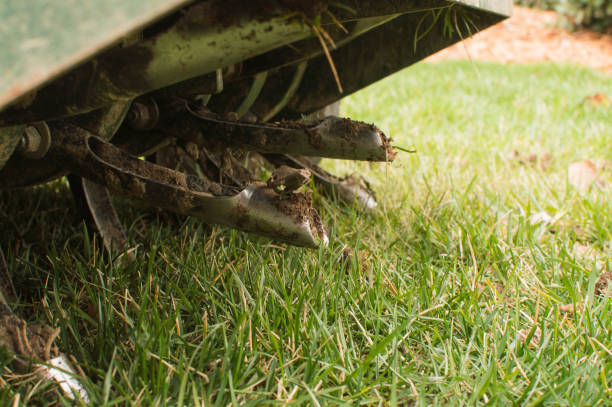
Homeowners who've accepted the case for core aeration usually arrive at one last question, asked with a slightly raised eyebrow: twice a year? Really? Once a year already feels like diligence — the twice-yearly recommendation sounds suspiciously like a service trying to double itself.
It's a fair challenge, and it deserves a real answer rather than a sales line. The honest response: on many soils, once a year is genuinely fine — and on North Texas clay, under real-world use, twice a year is the schedule that actually wins, for reasons rooted in how fast our ground re-compacts and how differently the spring and fall passes work. Here's the complete case for spring and fall core aeration — what each pass accomplishes that the other can't, and how to know which schedule your lawn actually needs.
The whole argument rests on one local fact: clay soil compacts constantly. Not from abuse — from existence. The microscopically fine particles of Parker County clay press tighter under every force applied to them: foot traffic, mower passes, pets, play, rain impact, and the soil's own settling weight. There is no maintenance level at which a clay lawn stops compacting; there's only the question of how far behind the correction runs.
Now run the math of a single annual aeration against that reality. One pass opens the soil beautifully — and then twelve months of continuous re-compaction work against it, so that by the time the next annual pass arrives, the lawn has spent its last several months substantially re-sealed. The annual schedule doesn't fail; it just spends part of every year losing ground. The twice-yearly schedule cuts the re-compaction window in half — the soil never gets more than about six months from its last opening — and that difference is what keeps clay ground continuously functional instead of cyclically rescued.
Spring aeration is the summer-preparation pass, and its value is entirely about what comes after it:
A lawn that aerates only in fall walks into every summer on soil that's had nearly a year to re-seal — carrying its most compacted ground into its most demanding season. That's the specific gap the spring pass closes.
Fall aeration is the recovery-and-banking pass, timed to a completely different moment in the lawn's year:
A lawn that aerates only in spring spends every fall recovery season fighting its own summer-hardened soil — rebuilding with one hand tied.
Here's the part the eyebrow-raise misses: spring and fall aeration aren't two servings of the same thing — they're two different jobs that reinforce each other, and the combination compounds in a way neither pass alone does:
This is why, on almost any North Texas street, the best lawns are so consistently the twice-a-year lawns: not because their owners bought more of a good thing, but because the two passes complete a cycle the single pass only half-runs.
Fairness requires the sorting, so here it is:
Twice a year (spring and fall) is the right call for: clay soil (that's the region), lawns with real use — kids, dogs, entertaining, foot traffic, new-construction yards fighting machine compaction (aggressively twice-yearly, for years), lawns on a turf program being pushed toward showcase condition, and any lawn where the compaction tests (screwdriver resistance, runoff, thin traffic zones) keep coming back positive between annual passes.
Once a year can genuinely suffice for: lightly used lawns, better-draining soil pockets, and budgets that have to choose — in which case, choose the pass matching the lawn's bigger problem (summers that scorch it → spring; general tiredness and weak green-up → fall).
And zero times a year suits nobody on clay. That schedule has a review section, and it's written in runoff and thin turf.
The twice-a-year recommendation, in the end, isn't a doubled service — it's a matched one: continuous compaction, met with a rhythm instead of a rescue. On this ground, that's just what maintenance means.

Put your soil on the winning schedule. Kangaroo Outdoor Solutions provides both spring and fall core aeration — irrigation flagged, deep hollow-tine cores, and perfect timing with your lawn's feeding calendar. Build your quote today and keep your clay open all year.