Winter looks like the off-season for lawn care. The grass is brown and dormant, the mower's parked, and the yard seems to be doing what everyone else is doing in January — nothing. But look closer at that dormant lawn, especially by late winter, and you'll spot the flaw in the off-season theory: green things, growing. Scattered patches at first, then spreading constellations, then — by February on unmanaged lawns — the full display: henbit's purple haze, chickweed's bright mats, clumps of cool-season grasses standing tall against the brown.
The lawn sleeps all winter. The weeds work all winter. And what happens in those quiet months decides more about your spring lawn than almost anyone realizes. Here's the case for winter weed control — what's actually growing out there, why the dormant season is when weeds are most vulnerable, and how the winter rounds of a turf program set up the whole year.
The winter weed roster is its own class of invader, running a calendar precisely opposite to your lawn's. These are the cool-season annuals: henbit — the square-stemmed one with the purple flowers that owns Texas lawns every February — chickweed sprawling in bright green mats, annual bluegrass with its pale seed heads, and the rosette-formers like several thistles quietly establishing through the cold.
Their strategy is elegant: germinate in fall as soil temperatures drop, grow through winter with zero competition — the turf that would normally crowd them is dormant and defenseless — then flower and drop thousands of seeds in early spring, completing the whole cycle before the lawn even wakes up. Every winter they run uncontested is a winter of free real estate and a massive seed deposit for future years. The dormant lawn isn't resting territory. It's an undefended field, and the winter class knows it.
Here's what flips the off-season logic on its head: winter is when these weeds are most exposed, for two clean reasons.
The first is visibility. Green weeds on a brown lawn are the easiest targets in all of weed control — every invader announcing itself against the dormant canvas, impossible to miss, easy to treat precisely. In summer, weeds hide inside green turf; in winter, they're highlighted.
The second is selectivity. With the grass dormant, treatments can work on the actively growing weeds while the sleeping turf sits safely uninvolved — a wider safety margin than any other season offers. The weeds are growing and vulnerable; the lawn is dormant and protected. It's the one season where the biology is entirely on your side.
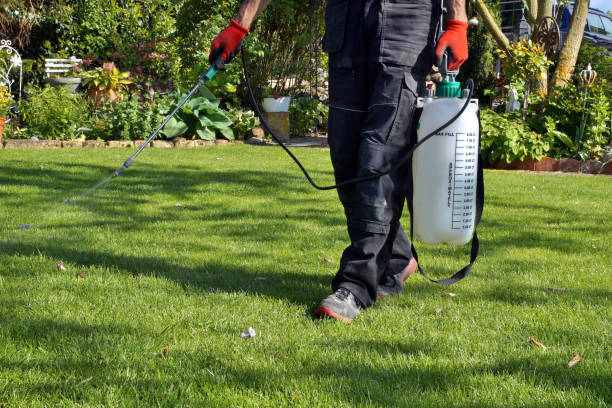
The winter rounds of a turf program exploit exactly this: broadleaf treatments applied on suitable days through the dormant months, eliminating the winter class while it's visible, vulnerable, and — critically — before it seeds. Every henbit plant killed in December is thousands of seeds that never enter your soil for next year.
Winter weed control has the most visible report card in lawn care: just look at any street in February. The unmanaged lawns wear the purple — henbit flowering across their dormancy, announcing to the neighborhood exactly which yards have no program. The managed lawns are clean brown — a uniform, tidy dormancy that looks intentional because it is.
But the cosmetic difference is the small half. The real payoff arrives at green-up. The lawn that spent winter weed-free wakes onto an open field: no established invaders occupying ground, stealing the early moisture and nutrients, or shading the soil the returning grass needs. The lawn that spent winter hosting the full class wakes into competition — its green-up contested by mature weeds with a three-month head start, its thin spots already claimed. And the seed-bank math compounds beneath both: the controlled lawn just banked a winter of zero deposits, while the uncontrolled one restocked for years.
This is also where the fall pre-emergent — the other half of winter defense — earns its place in the story: applied in early fall, it blocks most of the winter class from ever germinating, so the winter treatments face scattered survivors instead of a full population. Barrier first, cleanup second: the two-layer system that turns winter from the weeds' season into the program's.
The larger lesson winter teaches is the one that explains turf care generally: the lawn's calendar never actually stops — it just changes what needs doing. Winter's work is quiet, cheap, and decisive: a few well-timed treatments on visible targets, deciding whether spring opens on a clean field or a contested one. It's the least dramatic season of a turf program and one of the highest-leverage — which is exactly why programs run year-round while the weekend approach hibernates. The weeds are counting on the hibernation. The clean February lawns are the ones that didn't oblige.

Don't give the winter class a free season. Kangaroo Outdoor Solutions' Turf Control Program runs year-round — fall barriers, winter treatments, and a lawn that greens up onto a clean field. Build your quote today and win the quiet season.