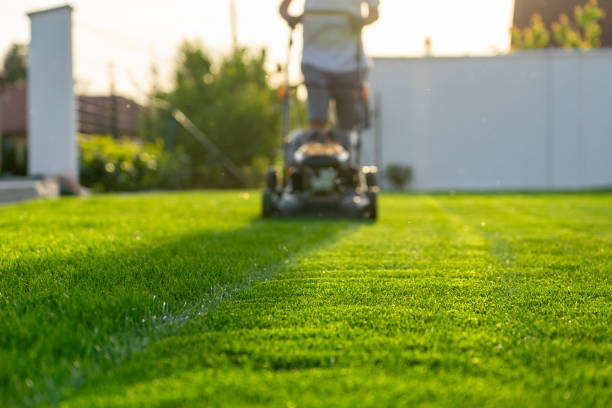
Here's a question most homeowners can't answer about their own yard: what grass is it? And here's why that matters more than it seems — nearly every important lawn care decision changes with the answer. The product that's safe on one Texas grass injures another. The mowing height that builds one lawn scalps the next. The diseases, the pests, the shade tolerance, the treatment calendar — all of it forks at the grass type, which means a treatment program that doesn't start with identification is guessing with chemicals.
Here's how the two dominant North Texas grasses actually differ, where the differences bite, and why grass-type fluency is one of the quiet things separating a real turf program from a bag off the shelf.
The region's lawns are overwhelmingly two grasses. Bermuda is the fine-bladed one — narrow leaves, dense low growth, spreading aggressively by runners above and below ground, thriving in full sun and taking traffic like a sports field, which is what it usually is. St. Augustine is the broad-bladed one — wide, flat, coarse-textured blades on thick surface runners, the carpet-look grass of shadier and older neighborhoods, notably more shade-tolerant than Bermuda and notably less tough underfoot.
A quick look at blade width settles identification on most lawns — and plenty of properties host both: St. Augustine holding the tree-shaded zones, Bermuda owning the sun. Mixed lawns raise the stakes on everything below, because every treatment decision now has two right answers on one property.
The single most expensive grass-type mistake in Texas lawn care is chemical. Bermuda tolerates a wide range of common lawn herbicides; St. Augustine's tolerance list is dramatically shorter — including several mainstream weed-and-feed and crabgrass products whose own labels warn against St. Augustine use, in print sized for nobody. Applied anyway, they yellow, thin, and in bad cases kill sections of the lawn — and every spring, a share of the damaged St. Augustine across Texas neighborhoods traces to exactly this: a product that was never safe for the grass it was spread on.
A professional program makes this mistake structurally impossible: product selection starts from grass identification, St. Augustine lawns get St. Augustine-safe chemistry, and mixed properties get treatments matched zone by zone. It's the least visible part of the service and the part that prevents the costliest self-inflicted damage.
The differences run through the everyday decisions too. Mowing height forks completely: Bermuda performs mowed relatively low and dense, while St. Augustine wants to be among the tallest-mowed grasses in Texas — cutting it at Bermuda height is chronic scalping that thins the lawn and invites every opportunist. A maintenance crew that knows the property adjusts deck height by grass, not just by season.
Sun and shade fork the expectations: Bermuda thins helplessly under canopy no matter the care, while St. Augustine holds decent turf in partial shade — which is why the honest answer for deep-shade Bermuda zones is conversion, and why St. Augustine owns the older tree-heavy streets. And the vulnerability lists fork the monitoring: St. Augustine is the preferred host of chinch bugs and the more fungus-prone grass in damp seasons, while Bermuda's weaknesses run to shade and scalping. Trained eyes watch different things on different lawns — the browning edge along a hot driveway means one investigation on St. Augustine and another on Bermuda.
Pull it together and the principle is plain: grass type isn't trivia — it's the first input to every correct decision that follows. The feeding rates, the herbicide selections, the mowing standards, the problem watch-list, even the recovery strategies when something goes wrong — all keyed to what's actually growing. A turf program's real product isn't the applications; it's the applications matched to the lawn, visit after visit, without a single label-warning mistake across years of treatments.
So if you've never been sure what's growing out front, that's fine — but make sure whoever treats it is. The first question a professional asks standing on a new lawn is the one this whole article is about, and the answer shapes everything they do next. Your grass already has a type. Your lawn care should too.

Get treatments matched to your actual grass. Kangaroo Outdoor Solutions' Turf Control Program starts with identification and builds every application around it — Bermuda, St. Augustine, or both. Build your quote today and treat the lawn you actually have.