A thin lawn is the most common complaint in all of lawn care, and the most misunderstood. The grass isn't dead — it's just sparse. You can see soil between the blades. The turf that should feel like carpet feels like scattered stubble. And the standard responses — more water, a bag of seed, another round of hope — never seem to move it.
Here's the thing about thin turf: it's not a condition. It's a symptom, and it always has causes — usually two or three stacked together. Density is what a lawn produces when its needs are met, and thinness is the lawn reporting exactly which needs aren't. Find the causes, fix them in the right order, and warm-season grass will do something remarkable: it will thicken itself, because spreading is what Bermuda and its relatives are built to do. Here's the full diagnosis and the rebuild plan.
Most thin lawns trace to some combination of five causes, and each leaves its own fingerprint.
The first is hunger. An unfed lawn thins the way an unfed anything does — gradually, generally, without drama. Grass consumes nutrients continuously through its growing season, and a lawn that hasn't seen a real fertilization schedule is running its density on fumes: pale color, slow growth, and a canopy that gets a little sparser every year. If your lawn hasn't been fed on a genuine seasonal calendar — not one random spring bag, but the full rhythm — hunger is almost certainly in your stack.
The second is compacted soil. Thin turf over hard ground is the North Texas signature: clay pressed tight by traffic and time until roots can't penetrate, water can't soak, and the grass survives in the top inch of workable soil. The fingerprint is thinness that follows use patterns — the path to the gate, the play areas, the edges where feet cut corners — plus the screwdriver test failing and water running off during irrigation.
The third is bad mowing. Chronic scalping — cutting too short, or infrequent cuts that remove half the blade at once — thins turf directly: every over-cut shocks the plant, pulls energy from the roots, and exposes soil that bakes and invites weeds. The fingerprint is thinness that's worst on the high spots and edges, brown tips after every mow, and a lawn that looks stressed on a weekly cycle.
The fourth is competition. Weeds don't just look bad — they occupy ground and consume the water and nutrients your grass needed, and every square foot they hold is a square foot of density your lawn can't build. Thin lawns and weedy lawns are usually the same lawn, in a feedback loop: thinness lets weeds in, weeds keep the turf thin.
And the fifth is shade — the honest structural cause. Bermuda thins dramatically under tree canopy because it's a full-sun grass, and no feeding or treatment changes the light. Thinness concentrated under trees is its own category with its own answers.
The instinctive fix — throw seed at the thin spots — fails for warm-season lawns almost every time, and it's worth understanding why. Most North Texas lawns are sodded Bermuda hybrids that don't come true from seed, common Bermuda seed struggles to establish inside existing turf, and — most importantly — seeding treats the symptom while the causes remain: seed scattered onto compacted, hungry, weed-occupied ground joins the existing grass in struggling. The good news that replaces the seed instinct: healthy Bermuda spreads itself, aggressively, by runners above ground and rhizomes below. Give the existing turf what it needs and it recolonizes its own thin ground — no seed required. The entire rebuild plan is just that: removing what blocks the spread.
Thickening a thin lawn runs a specific sequence, because each step enables the next.
Open the soil first. Core aeration attacks the compaction that's been capping the roots — thousands of extracted plugs letting water, air, and nutrients into ground that's been sealed. On a thin lawn this is the unlock: everything applied afterward actually reaches the root zone. Spring or fall timing, and on clay, plan the twice-yearly rhythm.
Feed the spread. This is where the turf control program becomes the engine of the whole rebuild: a proper fertilization schedule — the spring feeding fueling the growth surge, measured summer support through the heat, the critical fall feeding banking next year's reserves — supplies the fuel that lateral spreading runs on. Fed Bermuda on opened soil fills thin ground visibly within a season; the runners advance, the canopy closes, and the density that seemed impossible starts arriving on its own.
Clear the competition. The program's weed control runs alongside the feeding — pre-emergent shutting down the invasions before they start, targeted treatment removing the established weeds occupying your lawn's ground. Every weed removed is territory handed back to the spreading turf, and the pre-emergent barrier keeps it from being re-claimed.
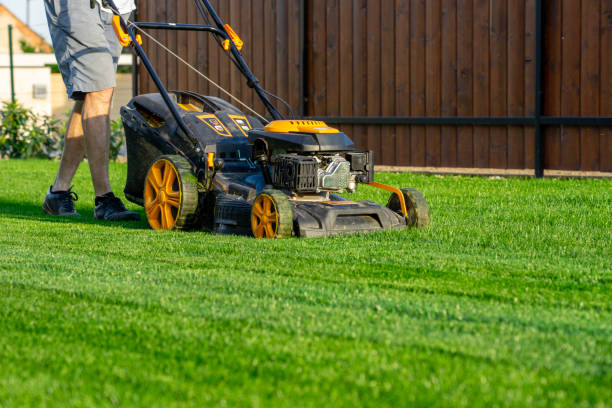
Fix the mowing. Weekly cuts in season, never removing more than a third of the blade, at proper height — with the height raised through summer. Frequent light mowing is literally a signal to warm-season grass to spread sideways, which means the mowing schedule itself is a densification tool. This is the step that costs nothing and gets skipped most.
And be honest about the shade. The zones under heavy canopy exit the turf project — converted to mulch beds or shade planting that will look deliberately better than struggling grass ever did — so the rebuild effort concentrates where it can actually win.
Set real expectations: the rebuild shows its first evidence within weeks — color deepening, the thin edges beginning to creep closed — and its real result across a full growing season, with year two delivering the lawn that no longer resembles the complaint. Density compounds: every season of the feeding rhythm, the open soil, the weed suppression, and the proper mowing builds on the last, which is exactly why the thick lawns on any street are the ones running the system, year after year. Thin was never the lawn's nature. It was the lawn's report — and now you know how to answer it.

Turn thin into thick the proven way. Kangaroo Outdoor Solutions' Turf Control Program pairs scheduled feeding and weed control with aeration and proper maintenance — the full density system, on one calendar. Build your quote today and start closing the gaps.