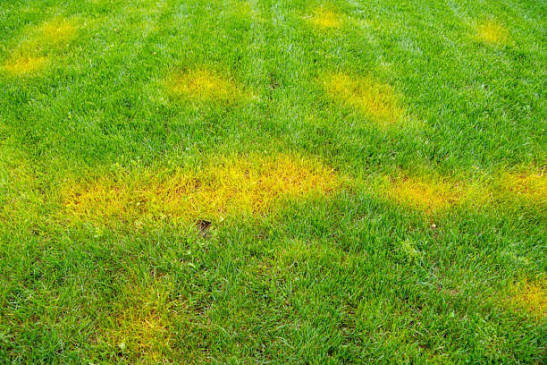
There's a specific lawn frustration that doesn't get enough attention: the lawn that isn't sick, exactly — no dead patches, no obvious disease circles, no visible pests — but has simply lost its color. The rich green faded to a washed-out yellow-green, or worse, gone genuinely yellow across whole sections, while the neighbor's lawn on the same street holds a deep emerald that seems to mock the comparison.
Yellow is a symptom with a surprisingly interesting cause list — and in North Texas specifically, one cause dominates that most homeowners have never heard of: iron chlorosis, a condition baked into the chemistry of our soil itself. Diagnosing the yellow correctly matters enormously, because the treatments for the different causes don't overlap: the fix for iron deficiency does nothing for nitrogen hunger, the fix for nitrogen hunger can worsen other problems, and throwing generic product at undiagnosed yellow is the classic way to spend money keeping a pale lawn pale.
Here's the complete color-diagnosis guide: the major causes of yellow turf, the field marks that tell them apart, and the fix for each.
Grass color is chlorophyll — the pigment doing photosynthesis — and chlorophyll production has a supply chain. Two nutrients sit at its heart: nitrogen (a core building block of the chlorophyll molecule itself) and iron (essential to the manufacturing process that makes chlorophyll). Shortage of either shuts down pigment production, and the grass yellows — a condition called chlorosis. But the two shortages happen for different reasons, in different patterns, and — this is the diagnostic gift — they yellow the grass differently. Add a handful of non-nutrient color thieves, and you have the full suspect list.
Here's the twist that makes iron chlorosis so common here: the soil usually isn't short of iron at all. North Texas soils are typically alkaline — high pH, thanks to the limestone underlying much of the region and the clay chemistry above it — and at high pH, soil iron gets chemically locked into forms that grass roots cannot absorb. The iron is present; it's just in a vault the plant can't open. The result: iron-starved grass growing in iron-rich ground.
The field marks — how iron chlorosis announces itself:
The fix — and the honest limits:
Treatment means delivering iron in forms that bypass the pH lock: chelated iron products (formulated to stay plant-available in alkaline soil) or foliar iron applications that feed through the blades directly. Responses can be satisfyingly fast — visible re-greening within days to a couple of weeks. The honesty: in strongly alkaline soil, iron treatment is management, not cure — the pH chemistry persists, so iron applications become a recurring part of the program for susceptible lawns, timed to the flare seasons. (Attempts to permanently acidify established lawn soil at scale are impractical; the chelated-iron rhythm is the working answer.) One caution that surprises people: iron products stain concrete rust-orange — professional application keeps them off your driveway, a small detail with very visible stakes.
The most common color problem nationally: the lawn simply isn't being fed enough for its growth demands.
The field marks: Nitrogen yellowing is the opposite pattern to iron — older blades yellow first (nitrogen is mobile in the plant, so it gets pulled from old growth to feed new), and the yellowing is a uniform, overall fade — the whole lawn drifting pale rather than new growth striping. Companion clues: slowed growth (mowing less often than the season warrants), thinning density, and a lawn that hasn't seen fertilizer in memory.
The fix: Feeding — the right product at the right seasonal timing, which is precisely the calendar a turf program runs. Response is reliable but measured in weeks. The caution runs the other direction: diagnosing iron chlorosis as nitrogen hunger and feeding hard pushes fast new growth that the iron supply can't green — making the yellow worse while stressing the lawn. Pattern-reading before product is the whole game.
Both directions of watering error read as yellow:
The fix: The irrigation audit before any product — run the zones, find the gaps and the leaks, correct the schedule. A meaningful share of "nutrient" yellow resolves with water delivery alone, because nutrients travel by water.
Rounding out the lineup — the yellows that aren't nutrition at all:
Compress it into the five-minute inspection: Pick blades and read the pattern — green veins on yellow, newest growth worst = iron; uniform fade, oldest blades worst = nitrogen. Map the yellow — along concrete = iron; in soggy zones = water/iron combined; in coverage-gap shapes = irrigation; in expanding patches = disease/pest playbooks. Check the calendar — cool wet spring flare = iron; long-unfed lawn = nitrogen; post-mow onset = blades. Then treat the diagnosis — chelated iron for the vault problem, seasonal feeding for the hunger, water correction for the extremes.
And the closing case for the program approach: color management is exactly the kind of ongoing, condition-reading work that scheduled professional care does natively — the trained eyes that catch the vein pattern in April, the chelated iron timed to the flare seasons, the feeding calendar that prevents the hunger, and the applications that never stain the driveway. Deep green isn't a product. It's a diagnosis, correctly treated, on repeat.

Tired of the pale lawn on a green street? Kangaroo Outdoor Solutions' Turf Control Program diagnoses and treats the real cause — iron programs for North Texas alkaline soil, seasonal feeding, and trained eyes on your color all year. Build your quote today and get your green back.